
How Do I Know if My Transmission Solenoid is Bad?
A bad transmission solenoid causes delayed or erratic shifting, slipping, harsh shifts, or a flat refusal to shift at all. Other warning signs are being stuck in one gear, a check engine light, unusual noises, and rising fluid temperature. All of it traces back to one thing: fluid pressure reaching the wrong clutch at the wrong time. An OBD-II scan plus a pressure test tells you which solenoid and whether the trans behind it is still healthy.
Solenoids are the electric valves that make an electronic automatic shift. They sit in or on the valve body, and the transmission control module fires them to route fluid to the clutches and bands. When one sticks, shorts, or plugs, the trans starts shifting wrong and making heat. Heat is what turns a cheap electrical fault into a rebuild, so read the symptoms early.
Delayed or Erratic Shifting
This is the one most people notice first. Shifts land at the wrong engine speed, too early, too late, or at random. The 1-2 shift fires at 2,200 rpm one time and 3,800 rpm the next with the same throttle input. Park to Drive or Park to Reverse engagement takes a noticeable beat longer than it used to.
The cause is a solenoid that cannot open or close cleanly, so pressure at the clutch pack is wrong when the shift is commanded. Delayed engagement on its own does not prove a solenoid. Low fluid, a failing TCM, a bad range sensor, or a worn pump will all give you the same feel. What it does prove is that you need a scan before you drive on it another week.
Transmission Stuck in Gear
If the trans locks into one gear, usually 1st or 2nd, and will not shift out, that is limp mode. Limp mode is a fallback the control module triggers when it sees a fault it will not risk shifting through. The car still drives, but rpm is capped and top speed is limited so the trans and the engine survive the trip to the shop.
A stuck shift solenoid or an open solenoid circuit is one of the most common limp mode triggers on GM and Ford electronic automatics. Get the codes read before you tow it anywhere. Limp mode is a symptom, not a diagnosis.
No Shifting or Skipping Gears
Worse case, the trans skips a gear entirely or refuses to shift at all. The control unit commands a shift, the correct clutch never applies at the correct pressure, and the trans either jumps to whatever gear it can hold or stays put. On a four speed you will feel a 1-3 shift with a flare in the middle. Driving in this state is what glazes clutches.
Check Engine Light Comes On
A check engine light is not always an engine problem. The same lamp covers the exhaust system and the transmission, and a bad solenoid will almost always set a stored code. You need a code reader to know which. These are the generic OBD-II codes that matter here:
- P0700: transmission control system malfunction, a pointer code that tells you to scan the TCM for the real fault
- P0750: Shift Solenoid A electrical fault
- P0755: Shift Solenoid B electrical fault
- P0760: Shift Solenoid C electrical fault
- P0765: Shift Solenoid D electrical fault
- P0740 and P0741: torque converter clutch circuit malfunction and performance or stuck off
- P0776 and P0777: pressure control solenoid B performance and stuck on
Read the code type, not just the number. An electrical fault means open circuit, short, or wiring, and it is usually the solenoid or the connector. A performance or stuck fault means the valve is moving but not doing what it was told, which points at debris, a worn bore, or a plugged screen.
Transmission Slipping
Slipping is the engine revving while the car does not accelerate the way the tach says it should. The trans has effectively fallen out of gear, or it is in gear with the clutch pack only partly applied. A failing solenoid starves that pack of line pressure, so the pack slips instead of holding.
Slip makes heat. Heat glazes the friction material. Glazed clutches slip more and make more heat. That loop is the reason a solenoid fault you ignore for a month becomes a full teardown.
Unusual Noises
Clunking, grinding, or whining from under the trans as the shift fires. The usual cause is shift timing gone wrong, where one clutch applies before the other has released and the driveline loads and unloads hard. A worn valve body will do the same thing, and so will a solenoid stuck partly open. If the noise only shows up on a specific shift, note which one. That tells the shop which circuit to test first.
Harsh or Rough Shifts
The opposite feel from slipping, same root cause. Instead of a soft flare, the shift hits hard enough to rock the car. Solenoids control not just which gear but how the gear engages, so a solenoid fault changes shift feel directly. On most modern units the pressure control solenoid sets line pressure, and a failing PCS can drive line pressure to maximum and hammer the driveline on every shift. Harsh shifts with no stored code are still worth a pressure test.
Downshift Issues
A bad solenoid breaks downshifts too. If the trans does not drop a gear as you hit the brakes or come to a stop, or it holds 4th when you ask for a passing gear, that is a shift solenoid or a TCC solenoid holding when it should release. Manually pulling the lever down and feeling the gear come in tells you the mechanical side is fine and the fault is electrical or hydraulic.
Transmission Overheating
A stuck solenoid holds pressure wrong across the whole valve body. Wrong pressure means slipping clutches, slipping clutches make friction heat, and fluid temperature climbs. Typical operating temperature on a healthy street automatic runs roughly 175 to 200 degrees F. Sustained temperature past about 240 degrees F is where fluid starts oxidizing fast and clutch life falls off a cliff. If you have a trans temp gauge and it starts reading high with no change in how you drive, scan it.
Poor Fuel Economy
If shifts are erratic, or the torque converter clutch solenoid is not commanding lockup at cruise, the engine turns more rpm than it should for the same road speed and burns extra fuel. A sudden two to three mpg drop with no other change is a real signal, especially on a highway commute. It is rarely the first symptom you notice, but it is often the one that confirms a TCC solenoid fault.
Symptom to Likely Cause
Symptom | Most likely cause |
Erratic shift points | Shift solenoid sticking |
Stuck in 1st or 2nd | Limp mode from solenoid circuit fault |
Hard, slamming shifts | Pressure control solenoid fault |
No converter lockup at cruise | TCC solenoid fault |
Slipping plus high temp | Low line pressure, worn clutches likely |
Where the Solenoids Live
Access and cost of repair depend entirely on which unit you have.
GM
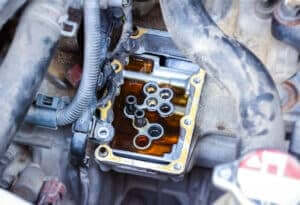
On the 4L60E, 4L65E, and 4L80E family, shift solenoids A and B, the TCC solenoid, and the pressure control solenoid are all on the valve body and reachable with the pan down. That makes these units the easiest of the group to diagnose and service without pulling the trans. The 4L60E and 4L80E also share enough architecture that the diagnostic sequence is the same on both. Non-electronic units like the TH350, TH400, and Powerglide have no shift solenoids at all, so if you are chasing a shift complaint on one of those, you are looking at governor, modulator, or valve body, not electronics.
Ford
On the 4R70W and 4R100 the solenoid body sits inside the pan, same idea as the GM units. On the E4OD and the later 6R80 the pack is more integrated and the electrical connector and internal harness are common failure points in their own right. Check the connector and the harness pass through before you condemn a solenoid on a Ford unit.
Modern six and eight speeds
On the 6L80E, 6R80, and 8L90, most of the solenoids come as one integrated solenoid pack or valve body assembly. You usually replace the whole unit rather than one solenoid, and many of these need a relearn or an adaptive reset afterward so the module stops using its old shift adapts. That is faster to install and harder to diagnose one circuit at a time.
How Do I Test a Transmission Solenoid?
Work in this order and stop when something fails.
- Check fluid level and condition first. Low, dark, or burnt ATF causes every symptom on this page and no solenoid will fix it.
- Scan for codes and record freeze frame data. Note whether the code is electrical or performance.
- Back probe the solenoid circuit at the connector and check for voltage and ground with the key on. A dead circuit means wiring or module, not solenoid.
- Measure solenoid resistance and compare it against the factory spec for your specific unit and year. Out of range means replace. Open circuit means replace.
- Drop the pan, cut the filter open, and look at what came out. Metal or clutch material means the trans is already damaged and a solenoid is only part of the story.
- Inspect and clean the solenoid screens. Plugged screens are one of the most common performance fault causes.
- After any repair, clear codes, run a full drive cycle through every shift, and pressure test.
If the fluid is burnt and the filter has clutch material in it, stop chasing the solenoid. You are looking at a rebuild or a replacement unit.
Will a Bad Solenoid Ruin the Transmission?
It can, and the timeline is shorter than people expect. A solenoid electrical fault caught in the first week is one of the cheapest things that can go wrong with an electronic automatic. The same fault driven on for a month with the clutches slipping and the fluid cooking will take out friction material, bushings, and often the pump. That is why limp mode exists. The module is trying to keep you from doing exactly that.
What Should I Do About a Bad Transmission Solenoid?
Scan it, test the circuit, drop the pan, and look at the fluid and the filter. If the solenoid is the only fault and the friction material is clean, replace it with an OE spec part, clear the codes, and verify with a road test and a pressure test. Skip the cheapest aftermarket solenoids. They fail early and you pay the labor twice.
If the trans is already past that, a rebuild on worn hard parts is money you spend once and then spend again. Gearstar builds and dyno tests every unit before it ships, with a calibrated valve body and quality spec solenoids installed as part of the build. Browse the full lineup of performance transmissions, or go straight to GM or Ford builds matched to your engine, torque number, and how you actually use the car. Call the shop at 330-434-5216 and spec your build.
More From the Shop
Should You Modify Your 4L60E Valve Body? Pros and Cons
Modifying your 4L60E transmission’s valve body can enhance shift performance and extend...
Upgrading Your 4L60E Valve Body for Performance
SUMMARY: Upgrade to a rebuilt valve body for firmer shifts, improved durability,...
Choosing the Right Upgrade for a Turbo 350 Transmission Pan
The GM TurboMatic 350 (TH350) is a legendary transmission, powering classic muscle...