
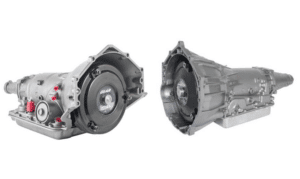
How Much Horsepower Can a 700R4 Transmission Handle?
How Much Horsepower Can the 700R4 Transmission Handle?
A stock 700R4 in good condition handles about 350 lb-ft of torque and roughly 300 to 350 horsepower. GM rated it to move a vehicle up to a 6,000 pound GVWR. Built with hardened internals, a recalibrated valve body, and a matched converter, the same case holds 500 to 700 horsepower on the street.
That is not a hard wall. It is the point where stock parts start spending their design life fast. Put a 500 horsepower small block in front of an unbuilt 700R4 and it will work. Then the sun shell splits, or the input drum twists its splines, or the pump wears and the trans starts slipping on the 1-2 shift.
Two 700R4s at the same power level can also be years apart in service life depending on what year case and shaft you started with. Race-only 700R4 builds using aftermarket cases and race clutch packs are advertised at up to 1000 lb-ft. Those are not street transmissions. They trade driveability, weight, and service life for one thing. Do not use that number to spec a car you drive to work.
Understanding the 700R4
GM built the 700R4 from 1982 through the end of the run, renaming it the 4L60 for the 1990 model year. It is a four speed automatic with a lock-up converter and a 30 percent overdrive. It bolts behind small block Chevy and small block Buick patterns without an adapter, which is why it shows up in swap after swap.
Stock gear ratios:
Gear ratios
- 1st: 3.06:1
- 2nd: 1.63:1
- 3rd: 1.00:1
- 4th overdrive: 0.70:1
The stock unit weighs roughly 170 lbs dry and measures about 29.875 inches on Corvette applications up to about 30.75 inches on other cars, including the aluminum housing. Plan your tunnel and crossmember around the specific case you have, not a spec sheet.
The 700R4 got better every few years. The early units used a 27 spline input shaft that is a known failure point. Later units run a 30 spline shaft, a revised oil pump housing, and an auxiliary valve body. The ring gear was revised between 1984 and 1987. Units built from 1987 through 1993 are the ones to start with if you have a choice. There is also the K case 700R4, built with a thicker housing for off road duty. The heavier case does not raise the torque rating. It survives flex and rough terrain better.
What Actually Fails First
The horsepower ceiling is set by parts, not by a number on a dyno sheet. Here is the order things let go.
Sun shell
The stamped steel sun shell is the classic 700R4 weak link. It splits at the splines under high input torque, usually on a hard 1-2 or a brake torque launch. A billet or forged sun shell is the first upgrade in any performance build.
Input drum and input shaft
Stock input drum splines twist under load, and an early 27 spline input shaft is thin for anything past stock power. A hardened drum and a 30 spline shaft are baseline on a performance spec unit.
2-4 band and servo
The 2-4 band eats the 1-2 shift. A wider high friction band with a larger apply servo raises apply force and stops the band from glazing.
Pump and boost valve
Stock line pressure is low for performance work. A boost valve raises pressure, firms the shift, and shortens the time the clutches spend slipping. Slip time is heat.
Torque converter
The stock converter is a low stall lock-up unit built for fuel economy. Behind a cammed engine it flashes below the power band and the car feels dead off idle. A matched stall converter, furnace brazed, is the single most important part on a built 700R4. Typical street builds land somewhere in the 2,000 to 2,800 rpm stall range depending on cam, weight, and rear gear. That figure gets set to the combination, not picked off a shelf.
Torque Matters More Than Horsepower
Horsepower sells. Torque breaks parts. Two engines making identical peak horsepower can load the drivetrain completely differently depending on where the torque lands and how fast it arrives.
A boosted small block making 500 horsepower with 550 lb-ft at 3,500 rpm punishes a 700R4 far harder than a naturally aspirated 500 horsepower engine that makes its torque at 5,500 rpm. Same headline number. Very different survival rate. When you spec a build, hand over the torque curve and the shift points, not just the horsepower claim.
Factors That Affect the 700R4's Horsepower Capacity
Driving style and vehicle usage
- Street cruiser, occasional wide open throttle: a healthy stock unit lasts.
- Weekend car with strip use: repeated launches and heat cycles make built internals the baseline.
- Tow rig: sustained load and heat. Cooling and clutch capacity matter more than peak power.
- Drag car: transbrake launches and slick hookup. Race clutches and a manual valve body are the minimum.
A 500 horsepower 700R4 that lives on the highway will outlast an identical 500 horsepower 700R4 that sees a launch a week at the track.
Vehicle weight and gear ratios
Weight is load, and load is heat. A 4,200 pound classic truck asks more of the same transmission than a 3,000 pound Nova at the same power level. Rear gear and tire diameter change it again, because they set how much torque multiplication reaches the transmission and what rpm you cruise at in overdrive. A tall tire with a highway gear can put the converter into lock-up at part throttle under load, which is a heat problem, not a shift problem.
Cooling and fluid
Every capacity number assumes the fluid stays in range. Automatic transmission fluid starts degrading past about 220 degrees F, and life drops sharply for every 20 degrees above that. Burnt fluid means glazed clutches and a slipping trans, in that order.
Above stock power, plan on an auxiliary cooler sized to the vehicle weight and duty cycle, quality fluid, and a temperature gauge in the trans line so you find out before the clutches do.
Diagnostic Sequence Before You Blame the Power Level
Most 700R4 failures blamed on horsepower are setup failures. Work in this order.
Symptom | Check first |
Slipping under throttle, soft shifts | TV cable adjustment and line pressure |
Harsh shifts, pump noise | TV cable too tight, boost valve setup |
No 4th gear or no lock-up | Wiring to the lock-up solenoid, brake switch |
Burnt smell, dark fluid | Fluid temperature, cooler sizing, converter stall |
Loss of 2nd and 4th | 2-4 band and servo |
Bang into gear, then nothing | Sun shell splines |
The TV Cable Is Why Most 700R4s Die Early
The throttle valve cable connects the carb or throttle body to the transmission and sets line pressure as a function of throttle position. It is not a kickdown cable and it cannot be left slack.
Too loose and line pressure stays low, the clutches slip on every shift, and the unit destroys itself in a few thousand miles. Too tight and pressure runs high everywhere, shifts hammer, and the pump takes the abuse.
Correct sequence: set the bracket so the cable housing is square to the throttle arm, adjust with the engine off and the throttle held at wide open, then release and reseat the slider. Set it per the correct procedure for your specific carb or throttle body, with the correct bracket geometry, and confirm you get full travel at wide open throttle. Then verify line pressure with a gauge rather than assuming it. On a carbureted swap this is the single easiest thing to get wrong and the most expensive.
Platform Behavior: What You Are Bolting It To
Carbureted small block: the 700R4 is the correct answer. No computer, no wiring, governor and TV cable control the shifts. Get the cable and the speedometer drive right and it is a clean install. Confirm the flexplate matches the converter bolt pattern before the trans goes up.
Vortec or early TBI swap: still workable, still cable controlled if you keep the mechanical throttle linkage. Watch the bellhousing pattern and the crank flange.
LS or modern electronic engine: use the 4L60E instead. Same ratios, same case dimensions, electronic shift control, and no TV cable to fight. You can run a 700R4 behind an LS with a cable bracket adapter, but you are adding a problem to solve a problem.
Comparing the 700R4 with Other GM Transmissions
700R4 vs 4L60E
The 4L60E is the electronically controlled evolution of the same architecture. Ratios and case dimensions carry over. The difference is control strategy. Electronic control gives precise, tunable shift points and lets a controller manage line pressure. If the engine is already computer controlled, the 4L60E is the better pairing. If it is not, the 700R4 is simpler and cheaper to make work.
700R4 vs 4L80E
The 4L80E is a different class of transmission, derived from the TH400 and engineered for real load. It is stronger and it is bigger. Expect tunnel work, a different crossmember, a longer tailshaft, and a shorter driveshaft. Once a build is honestly at 700 horsepower or above, or towing heavy at that power level, the 4L80E stops being an upgrade and becomes the correct part.
Classic compatibility with the 200-4R
The 200-4R is the compact overdrive option for classic GM cars. It fits BOP and Chevy patterns, it is physically smaller, and it drops into a G-body or an older car with less fabrication than a 700R4. Built well it handles serious power. The tradeoffs are availability and a shallower first gear, 2.74:1 against the 700R4's 3.06:1. If the car already has room, the 700R4 gives you the harder launch and a larger parts supply. See the full GM transmission lineup for how the options compare side by side.
Which 700R4 Do You Actually Need?
The right build is the one specified to your car, not to a horsepower bracket. Before anyone quotes you, have these numbers ready.
- Peak torque and the rpm it happens at
- Vehicle weight with driver and fuel
- Rear gear ratio and tire diameter
- Cruise speed and target highway rpm in overdrive
- Duty cycle: daily, weekend, strip, or tow
Those five inputs set the clutch count, the line pressure, the shift calibration, and the converter stall. A 400 horsepower street cruiser and a 400 horsepower autocross car should not leave the shop with the same transmission, and a shop that builds them the same way is guessing.
Gearstar builds each 700R4 performance transmission by hand, one builder start to finish, matched to your engine and use case, with a torque converter speced to the combination and a dyno test before it ships. Browse the full build lineup or call 330-434-5216 and spec your build with a builder.
More From the Shop
Is a 4L65E Stronger Than a 4L60E?
Wondering if the 4L65E transmission is stronger than the 4L60E? In short, yes. The 4L65E...
TH400 vs 4L80E vs 6L80E: Which GM Heavy Duty Automatic Belongs Behind Your Build?
All three of these will hold serious power. The question is not which one is...
What Happens If Your 700R4 TV Cable is Out of Adjustment?
SUMMARY:Throttle valve cables manage the hydraulic pressure and shift timing of your...