
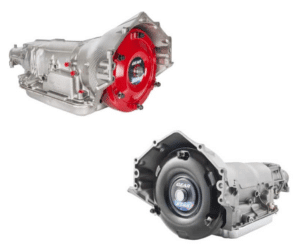
TH400 vs 4L80E vs 6L80E: Which GM Heavy Duty Automatic Belongs Behind Your Build?
The short version
All three of these will hold serious power. The question is not which one is strongest, it is which one matches the car you are actually building.
- TH400. Three speeds, no computer, no overdrive. The simplest way to put big power to the ground. Best for drag cars and anything that never sees a long highway pull.
- 4L80E. The TH400 with an overdrive and electronic control bolted onto the same heavy duty architecture. The default answer for a built street car that also needs to hold up.
- 6L80E. Six speeds, tight ratios, modern manners, and a lot more tuning and packaging work. Best when the car gets driven, and when someone competent is doing the calibration.
If you want the one line answer: for high horsepower drag and turbo builds, the 4L80E. For a street driven restomod that spends real time on the highway, the 6L80E is worth the trouble. For a car that only ever runs at the track, the TH400 is still hard to beat.
Where each one came from, and why that still matters
TH400
GM introduced the Turbo 400 in 1964. Three speeds, hydraulic control, no electronics of any kind. It went behind big blocks in Chevelles, GTOs, and heavy duty trucks, and it earned its reputation by not breaking. Sixty years later it is still a staple in class racing for exactly that reason.
4L80E
The 4L80E arrived in 1991 as the electronic successor to the TH400, and it is not a coincidence that they look related. GM took the TH400 architecture, added an overdrive gear and electronic control, and put it in Suburbans, Silverados, the Hummer H1, and commercial vehicles. Builders trust it because the platform came from a heavy duty design in the first place and responds well to upgrades.
6L80E
The 6L80E is a different design philosophy. Six forward gears, tighter ratio spacing, clutch to clutch shifting with no bands, and heavy reliance on electronic control and adaptive shift strategy. It went into newer GM trucks, SUVs, and performance cars where drivability and fuel economy carried as much weight as output.
Gearing and how each one feels
The TH400 and 4L80E share their first three ratios. The difference is that the 4L80E has a fourth gear overdrive and the TH400 does not, and that single fact drives most of the decision.
The 4L80E uses wide gear spacing, which gives you big rpm drops between shifts and a very direct connection between throttle and response. Fewer shifts under sustained acceleration. Less refined in traffic, more predictable under load, which for a lot of builders is a feature and not a compromise.
The 6L80E closes those gaps considerably. A much deeper first gear makes heavy vehicles feel genuinely aggressive off the line and gives you more freedom in rear gear selection. Six gears means the engine stays near its power band more of the time and the overdrive gearing drops highway rpm. It shifts more often but each shift is smaller, so it feels less like discrete gear changes and more like continuous pull.
Strength and what it takes to keep it
The 4L80E built its reputation on durability, and it typically needs fewer upgrades than most factory automatics to hold serious power reliably. That is why it keeps showing up behind turbo combinations, nitrous cars, tow rigs, and heavy vehicles making real torque.
That does not mean a core off a shelf is ready. At the power levels people actually run, input shaft, clutch capacity, valve body calibration, cooling, and converter selection all become the limiting factor before the case does. A professionally built 4L80E and a junkyard 4L80E are not the same transmission and should not be discussed as if they were.
The 6L80E is strong, but conditionally. At stock and moderate power it performs well and drives beautifully. As power climbs, calibration quality, clutch capacity, converter setup, and thermal management decide whether it survives. Tighter tolerances and a more advanced control strategy leave much less room for a half finished tune.
The TH400 is the simplest of the three to make live at high power, and that is precisely why racers keep using it. Gearstar builds TH400s to handle around 850 horsepower, and recommends it over a TH350 for big block street cars for that reason, with the caveat that it takes more power to turn than the smaller unit.
Electronics and control
The TH400 needs no controller at all. That is worth real money and real hours in an older car with no engine management to speak of.
The 4L80E integrates cleanly into older platforms with a standalone controller and does not lean on adaptive behavior, which makes it the practical choice for restomods and swap cars. Fewer variables, fewer things to sort out on a Saturday.
The 6L80E relies heavily on electronic control and ECU integration. Adaptive shifting helps drivability, and it also means calibration is not optional. Without proper tuning, shift quality and reliability both suffer. It rewards careful setup and punishes incomplete integration.
Swap reality: what actually stops people
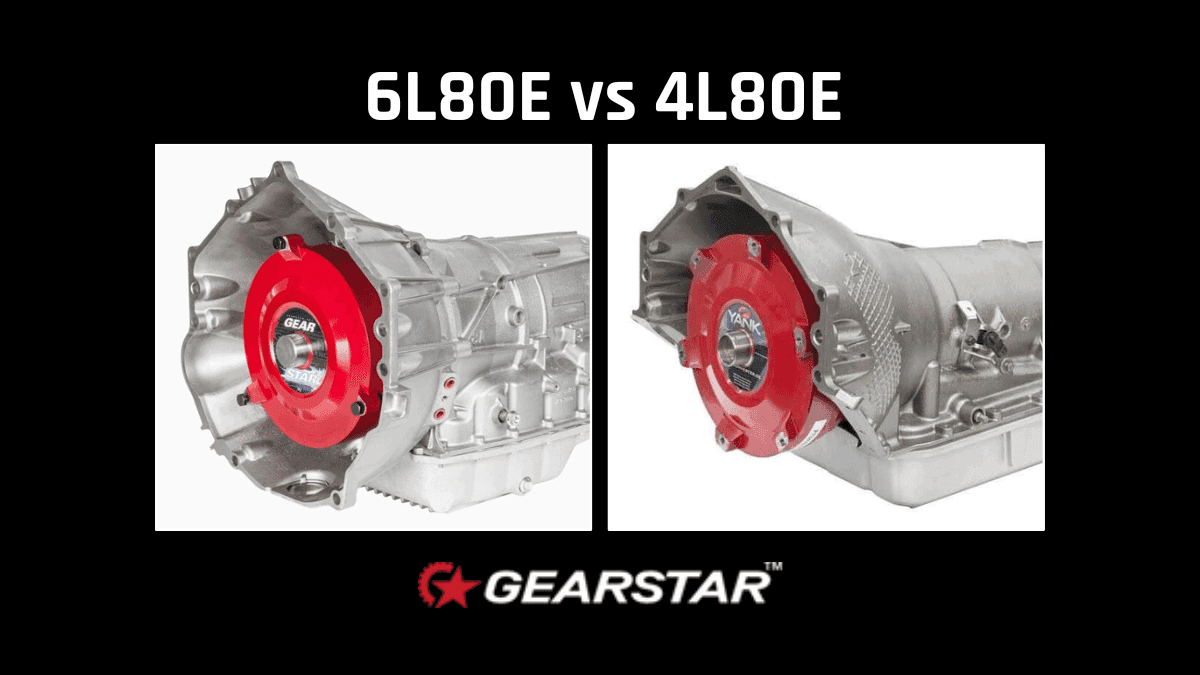
Swapping a TH400 for a 4L80E is doable and common, because the 4L80E was designed off the TH400. Same general dimensions. The 4L80E is heavier by roughly 57 pounds, about 187 pounds against 130 for the TH400, and it is longer, so you need a new driveshaft. Then you need electronic control. Chevrolet's SuperMatic controller will configure and fine tune it from a laptop, and there are several aftermarket standalone options.
The 6L80E is a different conversation. In a swap replacing a 4L60 or a 4L80, expect to cut the transmission tunnel and fabricate a new one. Its integrated bellhousing design and electronic requirements complicate older vehicles with standalone engine management. In most of these builds the physical fitment gets solved well before the wiring and tuning do.
In every one of these swaps, the next problem is the converter. Do not reuse the stock converter across a swap. The stock big block converter that lived behind a TH400 is the wrong piece for a 4L80E with an overdrive gear, and running a smaller, properly specified converter buys you weight, response, and a little fuel back on long trips.
Which one for which build
| Build | Pick | Why |
|---|---|---|
| Drag car, no highway miles | TH400 | Simple, strong, no controller, nothing to calibrate |
| High horsepower turbo or nitrous street car | 4L80E | TH400 strength plus overdrive, proven at power |
| Tow rig or heavy vehicle | 4L80E | Sustained load capacity and a deep rebuild ecosystem |
| Restomod with a standalone ECU | 4L80E | Easiest electronic integration into an older platform |
| Daily driven modern performance build | 6L80E | Six gears, lower cruise rpm, better manners in traffic |
| Tight tunnel, small chassis | Neither 4L80E nor 6L80E without fab | Both are big, one needs a tunnel, one needs a driveshaft |
Cost and living with it
The 4L80E benefits from decades of widespread use. Parts are familiar, rebuild paths are established, and everyone who touches transmissions has seen a hundred of them. The 6L80E has strong aftermarket support too, but complexity raises both rebuild cost and diagnostic time. Simpler systems stay cheaper to own. Modern systems demand more precise tuning and better diagnostic capability, and that cost does not show up until the second or third year.
The honest conclusion
There is no universal winner here, and anyone who gives you one has not asked enough questions about your car. Engine combination, vehicle weight, intended use, and power goal matter more than the badge on the case. One of these transmissions prioritizes mechanical simplicity and proven strength under extreme load. Another prioritizes drivability and modern shifting. Matching the transmission to the build is where reliability and performance actually meet.
Gearstar works directly with builders on exactly this call, taking power level, vehicle weight, gearing, and intended use into account before anything gets built. Every unit is assembled by one builder start to finish and dyno tested with its converter before it ships.
Frequently asked questions
Is the 4L80E stronger than the TH400?
Effectively yes. It is built on the TH400 architecture with an overdrive and electronic control added, and it carries heavier duty internals. The TH400's advantage is simplicity, not raw capacity.
Will a TH400 bolt in where a 4L80E was?
Dimensionally they are close, but the 4L80E is longer and heavier, so a driveshaft change is part of the job in either direction. Going to the 4L80E also means adding electronic control.
Is the 6L80E strong enough for a built engine?
It can be, with a proper build and a proper tune. At stock calibration and stock clutch capacity it is not the right pick for aggressive forced induction in a heavy car.
Can I reuse my torque converter in a swap?
No. Spec a converter for the transmission and the combination it is going into. This is where most swap complaints actually come from.
Get the right heavy duty automatic specified
Tell Gearstar the engine, the weight, the gear, and how the car gets driven, and get the transmission and converter specified together. Get an estimate for a custom built unit rather than guessing between three good options.
Build it once. Build it to hold.
More From the Shop
How Much Horsepower Can a 700R4 Transmission Handle?
A stock 700R4 in good condition handles about 350 lb-ft of torque and roughly 300...
Are 4L60E and 4L65E Interchangeable? Understanding the Differences and Compatibility
Physically, yes. The 4L60E and 4L65E share the same case, the same bellhousing bolt...
Is a 4L65E Stronger Than a 4L60E?
Wondering if the 4L65E transmission is stronger than the 4L60E? In short, yes. The 4L65E...