
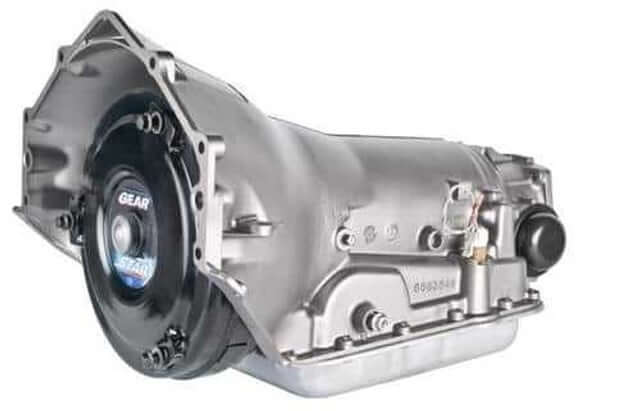
Is the Chevy 4L60E Transmission Good for Performance Builds?
Let’s discuss the Chevy 4L60E transmission for high-performance applications and explore its factory limits and reputation. We cover essential upgrades like hardened shafts, multi-disc clutches, and performance valve bodies needed to handle increased horsepower. Learn which power levels suit a built 4L60E and when to consider stepping up to a 4L80E for your project.
If you're deep into a performance build, whether it's a stout street machine, a weekend drag car, or a potent LS-swapped classic, you've likely encountered the debate. The GM 4L60E is everywhere. It came stock behind millions of V8-powered cars and trucks, which makes it affordable and readily available. But its reputation is a battlefield. You'll hear stories of these transmissions failing under stock power right alongside tales of them surviving years of abuse.
The problem is separating fact from folklore. Can this ubiquitous overdrive automatic truly be the foundation for a reliable, high-performance build, or is it destined to be the weak link that leaves you stranded?
At Gearstar, we live and breathe this question every day. The answer isn't a simple yes or no. The solution lies in understanding the 4L60E's inherent strengths and weaknesses, and knowing exactly what it takes, and what it costs, to transform it into a transmission capable of handling serious horsepower and torque.
The 4L60E's Legacy and Reputation: Understanding the "Glass" Perception
The Chevy 4L60E transmission is the electronic evolution of the venerable 700R4, which first brought overdrive to GM performance vehicles in the 1980s. It was designed for a balance of drivability and fuel economy, with its factory torque rating hovering around 360 lb-ft. This rating is a major source of its reputation.
GM placed this transmission behind powerful engines like the LT1 and LS1, which pushed right up against, and often exceeded, its designed limits from the factory. The result is a perception of fragility that isn't entirely fair but is rooted in reality.
The Chevy 4L60E transmission's weak spots are well-documented: the 3-4 clutch packs can burn up, the stock input shaft can twist, and the sun shell can crack under increased power and heat. Calling it a "glass" transmission isn't accurate, but it is a unit with known limits that require attention.
Key Upgrades: Building a Performance-Ready 4L60E
The reason the Chevy 4L60E transmission can be a fantastic performance transmission is that every one of its weak points has a proven, aftermarket solution. A properly built performance 4L60E is almost an entirely different animal than its stock counterpart.
At Gearstar, our performance builds start with a core that receives a suite of critical upgrades. This includes a hardened input shaft to prevent twisting and breakage under high torque. We install heavy-duty, multi-disc clutch packs to increase holding power and prevent the dreaded 3-4 clutch failure. The notorious sun shell is replaced with a heavy-duty version, often called "The Beast," to eliminate cracking. We also upgrade to a performance servo (like a Corvette-style servo) and a recalibrated valve body to increase line pressure for firmer, quicker shifts and longer clutch life.
These upgrades directly address the factory shortcomings and build a foundation capable of handling significant power.
Matching the Build to the Goal: Horsepower and Intended Use
The question of whether a Chevy 4L60E transmission is "good" for a performance build depends entirely on your power goals and how you plan to drive the vehicle. For builds up to around 450-500 horsepower, a well-built 4L60E with the upgrades mentioned above is an excellent, proven choice. It offers the huge advantage of a 0.70 overdrive ratio, which keeps highway RPMs low and makes it ideal for street-driven cars and trucks that see occasional track time or heavy towing. It retains a compact size that fits easily into most classic GM chassis without major tunnel modifications.
For builds pushing 500-750 horsepower, the equation changes. Building a 4L60E to survive at this level requires the absolute best parts and expert assembly. You're entering a cost bracket where the transmission becomes a premium item. At these higher power levels, the gear ratio advantage of a six-speed automatic like the 6L80E, with its 4.02 first gear, can provide a significant performance benefit, potentially improving acceleration despite adding some complexity and weight. For builds over 750 horsepower, the conversation shifts to the burly, nearly indestructible 4L80E.
The Gearstar Solution: Performance Matched and Dyno Tested
At Gearstar, we don't rebuild 4L60Es; we engineer them. Our approach is to build a complete, matched system. When you call us, we don't ask for just a model number. We ask about your engine's horsepower and torque, vehicle weight, rear gear ratio, tire size, and, most importantly, your intended use. Is it a weekend cruiser, a hard-launching drag car, or a truck that needs to tow? This information guides our selection of internal components and the custom calibration of the included torque converter.
Every Gearstar performance 4L60E, from our Level Two units rated for 450 hp to our higher-level builds, is assembled by a single technician and then dyno tested before it ships. This testing, which simulates over 100 miles of street driving under load, verifies shift timing, hydraulic pressures, and ensures the torque converter stall speed is perfectly matched to your camshaft and power curve. It's the final step that gives you confidence before you even bolt it in. We also offer solutions for control, including the Compushift stand-alone controller, which is perfect for engine swaps where the factory computer isn't present, allowing you to program shift firmness and points with ease.
4L60E Versions and Swap Considerations
Over its production run, the 4L60E underwent several changes that impact performance builds and swaps. The original 1-piece case, introduced in 1993, featured a 298mm input shaft, a 6-bolt bellhousing compatible with both big and small block Chevrolet engines, and a 13-pin main harness connector.
In 1998, GM introduced a 2-piece case that kept the 298mm input shaft and 13-pin harness but switched to a fully round bellhousing, eliminating the need for a dust cover while remaining compatible with the same torque converters. By 1999, the 2-piece 4L60/65E version appeared with a 300mm input shaft, a deeper bellhousing, and a 7th bellhousing bolt to accommodate LS engines, along with a longer torque converter pilot
Swap and converter considerations are also important. The 298mm 4L60E can bolt to LS engines but will miss the 12 o’clock bellhousing bolt, requiring a torque converter pilot spacer for proper fit. Later 300mm versions will bolt to both small and big block Chevys, but the torque converter may need a custom solution or spacer plate to ensure proper converter pull.
Conclusion
So, is the Chevy 4L60E transmission good for performance builds? Yes, absolutely, within its intended performance window. For the vast majority of street performance and mild-to-moderate racing applications, a professionally built 4L60E is a compact, overdrive-equipped, and highly effective transmission. The key is to be honest about your power goals and to choose a builder who doesn't just rebuild it, but re-engineers it for the task.
Don't leave your transmission choice to chance. Let the experts at Gearstar help you match the perfect Chevy 4L60E transmission to your project. Contact us today to discuss your build and discover how our performance-matched, dyno-tested transmissions can deliver the reliability and performance you demand.
More From the Shop
4L70E vs 4L60E: Specs, Internals, and Which One Your Build Actually Needs
The 4L60E and the 4L70E share gear ratios, a valve body layout that looks familiar,...
700R4 vs 4L60E: What To Know Before Upgrading
When it comes to GM overdrive automatics, few transmissions get talked about more...
4L60E Are They All The Same?
There have been several different versions of the 4L60E over the years. They started...