
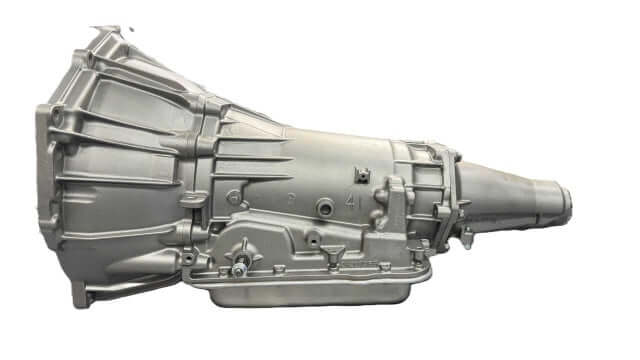
4L70E vs 4L60E: Specs, Internals, and Which One Your Build Actually Needs
Same ratios, different transmission
The 4L60E and the 4L70E share gear ratios, a valve body layout that looks familiar, the same case family, and the same overdrive operation. Externally you will not tell them apart. Everything that separates them is inside, and it all comes down to one question: how much torque are you putting through it, and how often.
Short version. Below roughly 425 lb-ft and 450 horsepower, a properly built 4L60E is the right piece. From there up into the 650 range, the 4L70E is the one that survives. Above that, you are having a different conversation entirely.
4L70E specs
- Type: 4 speed longitudinal automatic with lockup converter
- Manufacturer: General Motors
- Introduced: 2006, 2 piece case
- RPO code: M70
- Overdrive: Yes, 0.70 fourth gear
- Case material: Aluminum, removable bellhousing
- Control: Electronic, via the engine ECU
- Dry weight: approximately 133 lbs
Gear ratios, identical to the 4L60E: first 3.06, second 1.62, third 1.00, fourth 0.70, reverse 2.29.
The lineage, which explains the hardware
All of this starts with the 700R4, the first GM overdrive automatic that changed what was possible in a street car in the 1980s. The 4L60E followed with electronic control, and it evolved a lot more than the shared casting name suggests.
- 1 piece case (1993): 298mm input shaft, 6 bolt bellhousing for small and big block Chevrolet, 13 pin main harness connector.
- 2 piece case (1998): still a 298mm shaft, fully round bellhousing, dust cover eliminated.
- 2 piece 4L60/65E (1999): input shaft up to 300mm, a 7th bellhousing bolt for LS engines, deeper bellhousing and a longer converter pilot.
- 2 piece 4L70E (2006): keeps the 300mm shaft, adds either a 15 pin main harness for the input shaft speed sensor or a 17 pin harness for the speed sensor plus internal PRNDL switch.
What actually changed inside the 4L70E
The jump from 60 to 70 in the name is a torque capacity statement, and there is hardware behind it.
- Stronger clutches, upgraded steels, reinforced pump assemblies and recalibrated electronics throughout.
- The 3-2 downshift solenoid is gone. That location is cast shut, which means the valve body is a different casting and is not interchangeable with a 4L60E.
- Internal Mode Switch replaces the external NSBU switch. The manual shaft was reworked with internal flats and a hole to accept it.
- A transmission fluid temperature sensor that the earlier units did not have.
- Different output shaft and an added input shaft speed sensor.
- Completely different internal wiring and schematics, including the connector pin layout.
- Parking rod and pressure switch removed.
Because of all that, swapping parts between a 4L60E and a 4L70E is a bad idea unless the GM part numbers match exactly. You cannot convert a 4L60E into a 4L70E. If you want a stronger 4L60E, build the 4L60E with the right components rather than chasing 4L70E parts.
Telling them apart without opening anything
Two ways. The harness connector on a 4L70E is neon blue or black. If that is not conclusive, pull the service parts ID tag from the glove box and look for M70. Externally, there is no third method. Anyone claiming otherwise is guessing.
Driving feel, and where the difference shows up
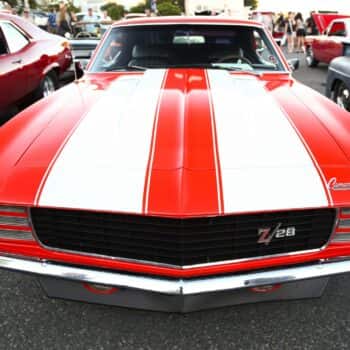
On the street, in a Camaro, a Corvette, or a half ton truck, these two feel the same. Identical ratios, identical overdrive behavior. Nobody blind tests them and picks the 4L70E.
The difference appears when torque exceeds what the lighter unit was designed for. Repeated hard launches, boost, towing, a heavy car. That is when the conversation stops being about how they drive and starts being about how they survive. Reinforced clutches, stronger pumps, and upgraded internals are what let the 4L70E take the hit consistently.
Can the 4L70E replace a 4L60E?
In most cases yes, it bolts right in, with real exceptions worth checking first.
- Confirm the harness connector and the input shaft size before you buy anything.
- You may need to swap the output shaft to the 4L60E or 4L65E version, or fabricate or modify a driveshaft to accept the new output shaft.
- The Trailblazer SS unit is different because of the all wheel drive setup. Do not assume it drops in.
- You need the correct powertrain control module to talk to it. In some cases the harness has to be re-pinned. This is not plug and play.
- The torque converter is the same between the two.
On bellhousing fitment more broadly: a 298mm input shaft 4L60E will bolt to an LS, but it misses the 12 o'clock bellhousing bolt and needs a converter pilot spacer. The 300mm shaft 4L60/65/70E family bolts to both small and big block Chevrolet, though converters may need a shorter pilot or a spacer plate for correct converter pullback.
What a 4L70E responds to when you build it
The platform takes modification well. A steel 5 pinion planet and a heavy duty input drum are the common durability upgrades. Some builders run a larger carbon fiber overdrive band for lower heat and better holding, others go to a heavy duty center shell for sustained track use. Because it is electronically controlled, you can calibrate converter lockup point and shift timing from a laptop or an aftermarket controller, which the old throttle valve cable units could never do.
That tunability is a real advantage on a swap car. Change tire size or rear gear and you adjust the calibration instead of pulling the pan.
Which one belongs in your build
Four questions get you to the answer.
- How much power will it see, and at what duty cycle
- How heavy is the car
- Street, track, or genuinely both
- Is the engine going to grow later
Light to moderate builds and street driven restomods do fine on a 4L60E. High output, forced induction, and anything that gets launched hard on a regular basis should be on a 4L70E. And if the plan is to add boost next year, build for next year now. Nobody enjoys paying to do this twice.
Build quality outranks the model number
This is the part that gets lost in every forum thread on the subject. A professionally assembled, dyno tested 4L60E will outlast a stock 4L70E in the same car. Matched clutch packs, the right pump assembly, and a valve body calibrated to the actual combination give you cleaner shifts, less heat, and a longer life than a stronger model number ever will on its own.
Gearstar builds both to tiered levels, where the core architecture stays the same and the internals are selected and calibrated for a higher threshold of stress. One builder handles a unit start to finish, and every transmission is dyno tested with its converter before it is crated.
Frequently asked questions
Is the 4L70E stronger than the 4L60E?
Yes. Reinforced internals let it handle higher torque and repeated hard launches. Figure the 4L70E for combinations running above roughly 425 lb-ft and 450 horsepower, up into the 650 range.
Are the gear ratios different?
No. Identical. Driving feel is virtually the same. The difference is internal strength.
Can I convert a 4L60E into a 4L70E?
No. The valve body casting, wiring, and switches are different. Build the 4L60E properly instead.
Will a 4L70E bolt to an LS?
Yes, it uses the 300mm input shaft and the 7 bolt LS bellhousing pattern. Confirm converter pilot depth.
Does the 4L70E need a different torque converter than the 4L60E?
The converter is the same between the two. What should change is the stall spec, which follows your engine, not the transmission model.
Have a 4L60E or 4L70E built for your combination
Give Gearstar the engine combination, the vehicle weight, the rear gear, and how the car gets used, and get a straight recommendation on which of these two to build and to what level. Ask for the estimate before you go core shopping, not after.
Build it once. Build it to hold.
More From the Shop
4L80E Upgrades: Top Performance Parts to Boost Your Transmission
Discover essential 4L80E upgrades, including the Gearstar Billet Direct Drum with...
Is the Chevy 4L60E Transmission Good for Performance Builds?
Let’s discuss the Chevy 4L60E transmission for high-performance applications and...
4R70W Transmission Controller Explained
This guide explains the 4R70W transmission controller, the electronic brain that...