
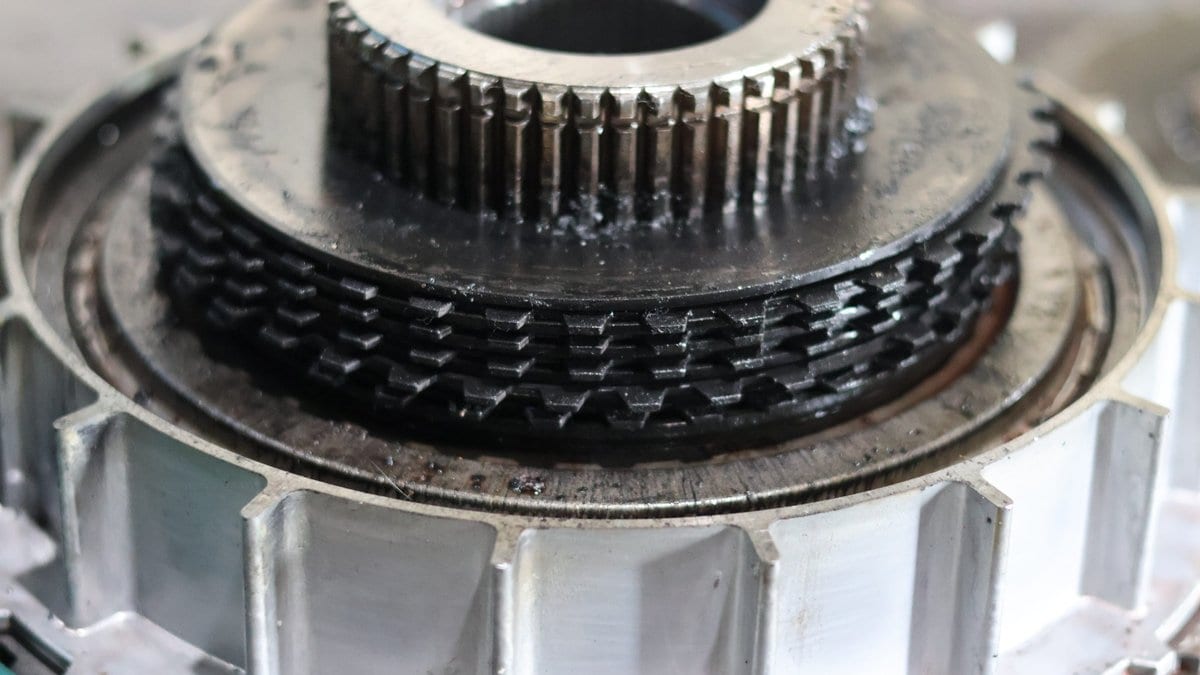
Automatic Transmission Failure: Catch It Before the Case Fills With Metal
Signs of Automatic Transmission Failure, and What They Cost You to Ignore
Automatic transmission failure is a heat problem, a pressure problem, or a control problem that got driven on. The unit that comes in on a hook with a cracked planetary and welded clutch material was telling somebody for weeks, and the tell is almost always slip, flare, or fluid that went dark.
That matters more behind a built motor than behind anything stock. Add cam, gear, tire, and a high stall converter and the transmission lives at loads and temperatures the factory never engineered around. The warning window is shorter, and the damage compounds faster, because every mile driven on a slipping clutch pack makes more heat, and heat is what caused the slip.
The Most Common Cause of Automatic Transmission Failure Is Heat
ATF does four jobs at once. It lubricates, it cools, it carries the hydraulic pressure that applies the clutch packs and bands, and it carries the friction modifiers that let those clutches grab clean instead of smear. Cook it and all four degrade together.
The order of degradation is predictable. Friction modifiers go first, so engagement gets soft and slippery before anything mechanical is worn out. Keep the heat on and the fluid varnishes, laying deposits in valve body bores and on clutch faces. Seals that live happily at 180F start hardening around 250F, and once they take a set they keep leaking after the trans cools back down.
Anything that adds load adds temperature: towing, stop and go, a high stall converter slipping by design, or a combination making more torque than the factory cooling circuit was sized to shed. A trans that is fine at 70 mph on the highway can cook itself in twenty minutes of low speed towing on a hot day if the cooler is not sized for the job. Cooling capacity is a build decision, not an accessory.
Behind heat, four things put units on the bench:
- Fluid contamination. Clutch and bushing material circulating through the valve body, scoring bores and hanging up shift solenoids.
- Low or wrong fluid. A slow leak nobody chased until the pump started drawing air, or a fluid spec that does not match what that valve body and friction material need.
- Mismatched build parts. A converter, valve body calibration, or shift kit spec'd against a horsepower number instead of the actual cam, gear, tire, and weight.
- Electrical and sensor faults. A failing input or output speed sensor, or a TCM acting on bad data, hammering clutch packs with shifts they were never meant to take at that pressure.
Every one of those is diagnosable before the unit quits. That is the difference between a $400 repair and a $4,000 rebuild.
Automatic Transmission Failure Symptoms, In the Order They Show Up
Delayed Engagement
Pull it into drive or reverse and there is a pause before the car moves. That is a pressure problem: the pump is not building line pressure fast enough, a clutch pack is worn enough that it needs extra travel to bite, or the level is low enough that the pump gulps air on initial engagement. A short hesitation cold can be normal. A delay that grows, or that shows up warm, is a wear pattern and it only goes one direction.
Slipping Under Load
RPM climbs and road speed does not follow. You feel it merging or climbing a grade, and on a strip car you feel it on the top end of second. The clutch pack or band is not holding applied pressure, because it is overheated, worn thin, or not getting the pressure it needs to lock. This is the symptom that snowballs fastest. Slip makes heat, heat kills what is left of the friction material, and the window from noticeable to teardown is measured in weeks of driving.
Burnt or Dark Fluid
Fresh ATF is red and close to translucent. Brown, black, or scorched means the fluid has already been past the point of doing its job. Pull the stick as routine, not just when something feels off. Burnt fluid is usually the earliest hard evidence you get, and it shows up before anything registers through the pedal.
Harsh or Erratic Shifting
Shifts that used to be firm and are now unpredictable point at the control side more often than the clutch packs: a sticking shift solenoid, a speed sensor feeding the TCM bad data, or valve body wear bleeding pressure where it should not. It is not just uncomfortable. Every abrupt shift is a shock load into gearsets and packs, and on a car making real torque that shock is the thing that breaks hard parts.
Whine, Hum, or Grind
A whine that tracks RPM but not gear selection is usually the pump or the converter, and low or aerated fluid is the first thing to rule out. A noise that changes with gear selection points at planetary or bearing wear. Grinding is metal on metal, which means hard particulate is already circulating through the cooler lines and the valve body. That is not a monitor-it symptom.
Leaks
A leak is rarely the failure. It is what causes the failure a few weeks later. Level drops far enough that the pump cavitates, pressure fluctuates, the packs slip, and the slip cooks the fluid. On a swapped car, check mount and crossmember angle before you keep replacing the same tailhousing seal.
No Engagement at All
The end stage, not the start. Significant clutch wear, a valve body that can no longer route pressure, or hard parts broken inside the case. Do not keep forcing it into gear. That is how a rebuildable core turns into scrap.
Minor Issue or Catastrophic Failure
The line is simple: upstream problems are fluid, pressure, and electronics, and they are usually fixable. Downstream problems are metal that has already been worn, burned, or broken.
| What you have | Which side it is on | The move |
|---|---|---|
| Low fluid from an external leak, caught early | Upstream | Fix the leak, refill, verify pressure |
| One failed solenoid or speed sensor | Upstream | Scan, replace the part, retest |
| Dark fluid that does not smell burnt | Upstream | Fluid and filter, then add cooler capacity |
| Slip that has been driven on for months | Downstream | Teardown, upgraded pack and hard parts |
| Grinding with metal in the pan | Downstream | Full build, spec'd to the torque |
| No engagement in any gear | Downstream | Tow it, do not drive it |
Pull the pan and read the magnet before you commit either direction. Fine clutch dust is normal wear. Shavings or chunks mean something already came apart, and a fluid and filter service will not put the material back.
Diagnose in This Order Before You Buy Anything
- Fluid condition and level. Color, smell, level. This alone resolves a large share of failing-transmission complaints and costs nothing.
- Codes and live data. TCM faults plus live line pressure, solenoid duty cycle, and input and output speed. A lot of what feels mechanical is the control system reacting correctly to a bad sensor.
- Line pressure test. Confirms the pump and valve body build and hold the pressure the packs need to apply fully. Low pressure with clean fluid and no codes points at pump or valve body wear.
- Stall test, carefully. Separates converter and lockup clutch behavior from gearset and pack problems.
- Pan and filter. What is on the magnet tells you what has already been consumed inside the case.
Skipping to a replacement without that sequence means paying for a unit to fix what might have been a solenoid pack.
Rebuild or Replace
Rebuild when the case, shafts, and planetary gearsets are intact and the damage is in wear items: clutches, bands, seals, a tired valve body. A rebuild is also the right moment to stop matching the stock spec, since stronger packs, a corrected valve body calibration, and a matched converter all go in together at that point.
Replace with a unit built for the application when there is case damage, a cracked carrier, shaft damage, or when it has been driven hard while slipping or grinding long enough that nobody can scope the damage without a full teardown anyway. At that point the labor to inspect is most of the labor to rebuild.
The real deciding factor is upstream of all of it: was the transmission in the car ever matched to the engine, gearing, and how the car gets driven? A unit that failed because it was undersized for the combination will fail again if it goes back in unchanged.
Two Install and Tuning Mistakes That Burn Up Transmissions
Incorrect TV Cable Adjustment
On the Ford AOD, the GM 200-4R and the 700R4, the throttle valve (TV) cable sets line pressure. Get the adjustment wrong and the transmission runs without enough line pressure to hold the clutches. They slip, the slip makes heat, and the unit burns up. It is one of the biggest failure risks on these three transmissions, and it is a setup mistake, not a bad part.
Ford and GM use different adjustment procedures, so a method that works on one will not carry over to the other. If you are installing a Gearstar transmission, follow the installation packet that ships with it, and call our tech department to walk through the TV cable adjustment rather than guessing. More on the GM side: TV cable adjustment and what happens when a 700R4 TV cable is out of adjustment.
Improper Tuning on Electronic Transmissions
On an electronically controlled transmission, line pressure, shift timing and converter clutch apply all live in the calibration. A tune written for a different build, or a stock calibration left behind a modified engine, can work the clutches harder than they were built for. Our tech support works with customers on many aftermarket and factory control systems to review the settings and make sure they suit the transmission build.
Prevention That Actually Moves the Number
Fluid and filter on a real interval, shorter than the factory schedule for anything towing, running higher stall, or living in stop and go heat. An auxiliary cooler sized for the load the build makes, not the load the factory application made. A fluid temp gauge, which protects a build better than most bolt-ons. And converter stall matched to the combination, because a mismatched converter makes slip-related heat every mile the car moves, not just when you are on it.
Build It for the Combination and This List Stops Applying
Most automatic transmission failure behind a modified engine is not a bad part. It is a unit spec'd for one power level being asked to live at another.
That is why Gearstar builds one way. One technician assembles your unit start to finish, it is matched to your engine, gearing, and driving style, and it runs on the dyno for 100 miles before it ships. You get the dyno video of your transmission under load, not a stock clip, and the build carries a warranty. No generic core off a warehouse rack, no hoping the application is close enough.
Tell us the combination: engine, cam, gear, tire, converter target, and weight. We will spec the unit around it.
Spec it right, and it stops being the weak link.
FAQs
What is the most common cause of automatic transmission failure? Heat. ATF lubricates, cools, carries hydraulic pressure, and carries the friction modifiers that let clutches grab. Sustained high temperature degrades all four at once, starting with the friction modifiers, which is why engagement gets soft before anything is mechanically worn out. Undersized cooling behind a build making real torque is the usual root cause.
What are the signs of automatic transmission failure? Delayed engagement, slipping under load, dark or burnt smelling fluid, harsh or erratic shifts, whine or grind, and external leaks. They usually arrive in roughly that order and end with no engagement at all. Slip and burnt fluid are the two worth acting on immediately, because both cause secondary damage while you decide.
What are the earliest automatic transmission failure symptoms? Fluid condition and engagement quality. Fluid that has gone dark or smells scorched is often the first hard evidence, showing up before the driver feels anything. Behind that, a delay going into gear that gets longer as the unit warms, and RPM climbing faster than road speed under load.
Can you drive with signs of transmission failure? It depends which side of the line you are on. Harsh shifts, a small leak, or dark fluid without grit will get you to the shop. Slipping, grinding, or no engagement will not, and driving on them turns a rebuildable core into scrap. Metal in the pan means it gets towed.
How do I know if it is the transmission or the control system? Scan it before you pull it. TCM codes and live data on line pressure, solenoid duty cycle, and input and output speed separate a sensor or solenoid fault from mechanical wear. A lot of failure-feeling behavior is the control system reacting correctly to bad input, and that is a cheap fix compared to a teardown.
Do performance transmissions fail less often? Only when they are built for the actual combination. Clutch count and friction material rated for the torque, line pressure calibrated to the application, hard parts that suit the load, and converter stall matched to cam, gear, tire, and weight remove the causes on this list. A generic rebuild with a shift kit in it does not.
What does it cost to ignore early signs of transmission failure? Ignoring the upstream symptoms moves the job from fluid, a sensor, or a seal to a full teardown with contaminated cooler lines and a converter that has to be cut and rebuilt. The source range on that jump is roughly $400 versus $4,000 [confirm 2026 range]. Slip and flare are the last cheap symptoms you get.
Can a bad TV cable adjustment ruin a transmission? Yes. On the Ford AOD, GM 200-4R and 700R4, the TV cable sets line pressure. Adjusted wrong, the transmission runs without enough pressure to hold the clutches, they slip, and the heat burns the unit up. Ford and GM use different procedures, so follow the installation packet for your transmission and call tech support if you are unsure.
More From the Shop
8L90 Transmission Problems: What Fails First Behind Real Power
Five things account for most 8L90 complaints: torque converter shudder, harsh or...
Automatic Transmission Problems: 10 Signs a Built Car Gives You First
A transmission almost never quits without warning. It slips, it flares, it hangs...
GM Transmission Problems: Common Issues in Cars and HD Trucks
You feel a slip on the 2-3 shift, a flare under load, or a shudder at highway...