
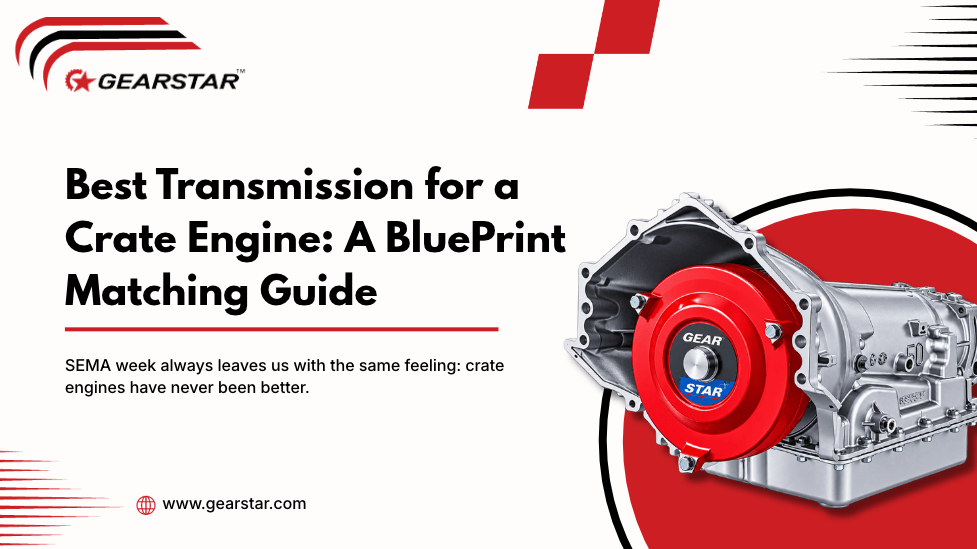
Best Transmission for a Crate Engine: A BluePrint Matching Guide
The Engine Is Half the Decision
SEMA week always leaves us with the same feeling: crate engines have never been better. Walk any aisle and there is a fresh small block, an LS or a big block on a stand with a dyno sheet taped to it. Buying a turnkey engine has never been easier.
Here is the problem. That crate engine shows up with a dyno sheet, and the transmission behind it gets picked on price, at the very end, when the budget is gone. That is the order a lot of drivetrain failures start in. This guide walks you from the crate engine you picked to the transmission and converter that will live behind it, using the BluePrint crate engines we sell as real examples.
One thing up front: this is a matching guide, not a chart. We spec every transmission to the full application, so the goal is to show you what changes the answer and what to bring when you call.
Torque, Not Horsepower, Is What the Transmission Feels
Look at the torque number on the dyno sheet first, and where in the rpm range it shows up. That is the load your transmission carries every time you leave a light. Two engines with similar horsepower can be very different to live with if one makes its torque low and hard.
The BluePrint lineup shows the spread. A 383 small block is rated at 436 hp and 443 ft-lb. A naturally aspirated 427 LS is rated at 605 hp and 565 ft-lb. A supercharged 427 LS is rated at 830 hp and 800 ft-lb. Those are three different transmission conversations.
Five Things That Change the Answer for the Same Engine
- Vehicle weight. The same engine in a 3,200 pound Nova and a 4,800 pound C10 is a different job for the transmission.
- Rear gear and tire size. Deeper gears and bigger tires multiply the load. Taller gears change which first-gear ratio you want.
- How it gets driven. Street, strip, towing and off-road each put heat and load in different places.
- Power you plan to add. If a blower or a bigger cam is coming next year, spec for that, not for today.
- Launch style. A car that leaves hard on sticky tires loads the transmission far more than one that rolls into the throttle.
How BluePrint and Gearstar Pair Them Today
BluePrint sells several of its crate engines as complete packages with an automatic already matched. Those pairings show how the decision works in practice:
| BluePrint package | Engine rating | Automatic |
|---|---|---|
| 376 c.i. LS, EFI (Builder Series) | Up to 530 hp / 495 ft-lb | 4L70E |
| 427 c.i. LS, EFI (Builder Series) | 605 hp / 565 ft-lb | 4L70E |
| 376 c.i. LS, supercharged (Builder Series) | 700 hp / 640 ft-lb | 4L80E |
| 427 c.i. LS, supercharged (Builder Series) | 830 hp / 800 ft-lb | 4L80E |
| 347 c.i. Ford, Mustang Edition | 415 hp / 415 ft-lb | 4R70W |
The pattern is clear. Naturally aspirated LS packages run the compact 4L70E, the stronger member of the 4L60E family. Once a supercharger pushes torque past what that family is built for, the package moves to the heavy-duty 4L80E. You can browse them under engine and transmission assemblies.
Small Block Crate Engines
A carbureted or EFI small block is the most common crate engine we see, and it has the most transmission choices:
- 700R4 or 4L60E family for an overdrive street car. The 700R4 runs on a TV cable, the 4L60E family needs a controller. Both give you a deep first gear and a 0.70 overdrive.
- TH350 or TH400 for simple, strong and no electronics. The TH400 is the choice as torque and weight go up.
- 4L80E when you want overdrive behind a lot of torque or a heavy vehicle.
A 383 at 443 ft-lb in a light street car is well inside what a built 700R4 or 4L60E handles. Our 2WD 700R4 Level 3 and 4L60E Level 3 are both rated to 500 hp and 500 ft-lb. The same 383 in a heavy truck that tows is a different call.
LS Crate Engines
Behind an LS, the choices are mostly the 4L60E family, the 4L80E and the 6L80E. As the BluePrint packages show, the compact 4L70E covers a lot of naturally aspirated LS combinations, and the 4L80E takes over when boost or a heavy vehicle pushes torque up. A 6L80E is the pick when you want six speeds and modern highway manners. For fitment, wiring and controller options, see our LS swap transmission guide.
Big Block Crate Engines
Big blocks are where the TH400 and 4L80E earn their place. When an engine makes 600 to 700-plus ft-lb, everything behind it has to be sized for it: the converter, the cooler, the driveshaft and the rear end, not just the transmission case. Our TH400 builds are rated from 400 hp at Level 1 to 1,000 hp at Level 4 in 2WD, and our 4L80E builds from 500 hp at Level 2 to 1,000 hp at Level 5, with a 1,200 hp Pro Series above that. See the TH400 and 4L80E builds.
The Converter Is Part of the Match
A crate engine with a mismatched converter will never drive right. Stall has to fit the cam, the gear, the weight and the use. The most common mistake we see is too much stall. It makes heat and stacks shifts at wide-open throttle. A good target is an 800 to 1,000 rpm drop between shifts. Bring the cam card, with duration at .050, lift and lobe separation angle. Our stall converter guide covers the rest. Every Gearstar transmission ships with a converter built for it, and the two are dyno tested together.
Cooling and the Parts People Skip
- Transmission cooler. Big torque makes big heat. Size the cooler for the engine and the use.
- Lines and fittings. Use lines sized for the cooler, routed away from headers.
- Crossmember and driveshaft. A new transmission usually means a new mount location and a new driveshaft length.
- Controller. An electronic transmission needs a controller matched to it and to the engine.
What to Have Ready Before You Call
- Engine model and dyno sheet
- Cam card
- Vehicle, weight and use
- Rear gear ratio and tire size
- Power you plan to add later
- Controller preference for electronic units
With that list, we can spec the transmission, converter and supporting parts as one package. Every Gearstar unit is built start to finish by one technician and dyno tested for the equivalent of 100 miles before it ships, and you get a video of your transmission on the dyno. Get an estimate for your crate engine build.
FAQs
What transmission do I need for a crate engine?
It depends on the engine's torque, the vehicle's weight, the rear gear and tire, and how you drive. Start with the torque number on the dyno sheet, then match the transmission and converter to the whole application.
What transmission do I need for a 500 hp crate engine?
Several can work. A built 700R4, 4L60E family unit, TH400 or 4L80E can all live behind 500 hp in the right vehicle. Weight, torque, gearing and use decide which one is the best fit.
Can a 4L60E handle a 383 stroker?
A built one can in the right application. A BluePrint 383 is rated at 436 hp and 443 ft-lb, and our 2WD 4L60E Level 3 is rated to 500 hp and 500 ft-lb. A heavy vehicle, towing or more power planned can change that answer.
Should I buy the engine and transmission as a package?
It is the easiest way to get a matched drivetrain. BluePrint sells several crate engines with an automatic already matched. If you buy them separately, spec the transmission with the engine's dyno sheet and your vehicle details in hand.
Do I need a different converter for a crate engine?
Almost always. The converter has to match the engine's cam and torque curve, the gear, the weight and the use. A converter that came out of a stock vehicle rarely fits a crate engine build.
More From the Shop
Is a Built Transmission Worth It? What the Price Buys and the 7 Questions Buyers Ask
One shop says $2,500. We say closer to $5,000 to $10,000, depending on the unit and...
LS Swap Transmission Guide: Picking the Right Automatic Behind Your LS
We just got back from SEMA, and the LS swap is still the engine of the whole...
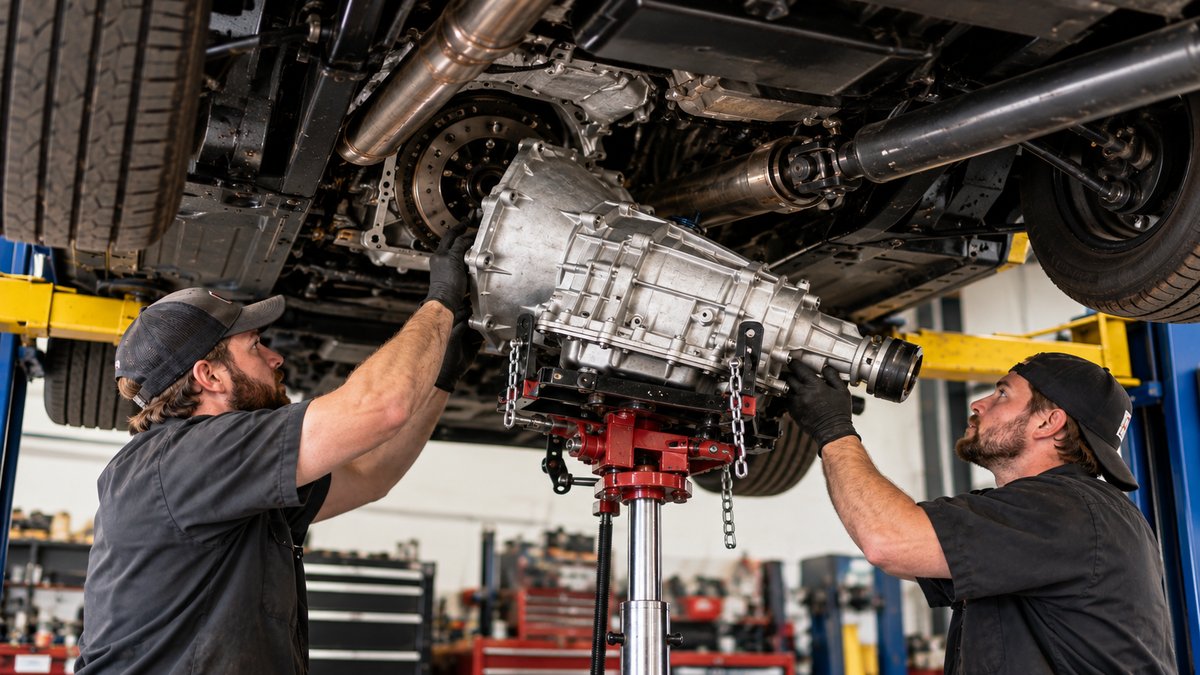
How Much Does It Cost to Replace a Transmission? What a Built Car Actually Pays
A transmission replacement runs from about $2,500 to more than $12,000. Where you...