
LS Swap Transmission Guide: Picking the Right Automatic Behind Your LS
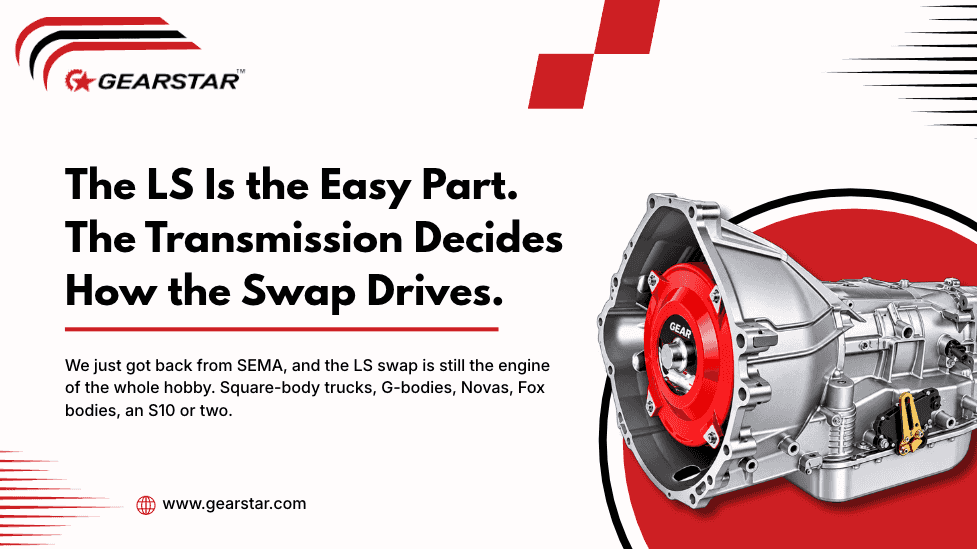
The LS Is the Easy Part. The Transmission Decides How the Swap Drives.
We just got back from SEMA, and the LS swap is still the engine of the whole hobby. Square-body trucks, G-bodies, Novas, Fox bodies, an S10 or two. The engine choice is almost never the hard call anymore. A junkyard 5.3, a 6.0 truck engine or a crate 376 all make good power and bolt to the same bellhousing pattern.
The transmission is where swaps go right or go sideways. Pick the wrong automatic and you end up with a car that shifts badly, a tunnel that needs a hammer, a controller that will not talk to the engine, or a transmission that gives up the first summer it sees real heat. This guide covers the three automatics we build for LS swaps most often, what each one asks of the chassis, how to control it, and what the whole job really costs.
The Realistic Options Behind an LS
Almost every LS swap we spec ends up behind one of three GM automatics. All three share the LS bellhousing pattern, and all three are electronically controlled.
| 4L60E / 4L65E / 4L70E | 4L80E | 6L80E | |
|---|---|---|---|
| Gears | 4-speed overdrive | 4-speed overdrive | 6-speed, two overdrives |
| Ratios | 3.06 / 1.63 / 1.00 / 0.70 | 2.48 / 1.48 / 1.00 / 0.75 | 4.03 / 2.36 / 1.53 / 1.15 / 0.85 / 0.67 |
| Size | Compact, lightest of the three | Long and heavy, descended from the TH400 | Longer than a 4L60E, and needs a modern controller and calibration |
| Where it shines | Lighter street cars, tight tunnels, simple swaps | High torque, heavy vehicles, boost, towing | Modern drivability, highway gearing, late-model LS and LT |
| Gearstar 2WD ratings | 4L60E Level 3 to 500 hp, Level 4 to 650 hp, Level 5 to 700 hp | Level 2 to 500 hp up to Level 5 at 1,000 hp, Pro Series at 1,200 hp | Level 3 to 650 hp, Level 4 to 750 hp |
Those ratings come from our product pages, and they are ceilings, not targets. Two LS swaps at the same horsepower can need different builds because of weight, gearing, tire and how the car gets driven. That is why we ask about the whole combination before we recommend a level.
4L60E, 4L65E and 4L70E: The Default for a Reason
The 4L60E family is the most common LS swap transmission because it fits. It is compact, it bolts up to the LS, and its 3.06 first gear gets a car off the line hard. In a 3,200 pound street car with a mild cam, a built 4L60E is often exactly right.
Where it gets into trouble is torque, heat and weight. A stock 4L60E was built for factory power in factory vehicles. Behind a cammed 5.3 or a stroked 6.0 in a heavy truck, the 3-4 clutch pack, the sun shell and the input drum are the parts we see give up first. A built unit fixes those weak points with more clutch capacity and stronger hard parts. Our 4L60E horsepower guide goes through what fails at each power level.
4L80E: When the Combination Outgrows the 4L60E
The 4L80E is GM's heavy-duty four-speed, and it is what we reach for when the torque, the weight or the plans get serious. As a rough line, we start looking at a 4L80E when a build makes more than about 650 horsepower, sees drag racing or extreme duty, or has more power planned. A boosted LS is the classic case. BluePrint pairs its supercharged 376 and 427 LS crate engines with the 4L80E for exactly this reason.
The tradeoff is size. The 4L80E is longer and heavier than a 4L60E, it often needs tunnel or firewall clearance, and the side-mounted harness connector needs room. Expect crossmember and driveshaft changes. Our 4L60E vs 4L80E guide walks through the full comparison.
6L80E: Modern Gears for a Modern Engine
The 6L80E gives you six speeds, a deep first gear and two overdrives. That makes it the pick when you want a swap that drives like a late-model car: low cruise rpm, quick shifts and better highway manners. It came behind a lot of the same engines people swap, so the parts are out there.
The catch is control. The 6L80E needs a modern controller and calibration, and it is less forgiving of a half-finished wiring job than a 4L60E. Behind a cam or boost, the converter clutch also becomes a spec item, not an afterthought. Our 6L80E builds use a custom billet converter with friction material we bond in-house for this reason.
Fitment: Measure Before You Order
Every chassis is different, but these are the checks that decide how much work a swap really is:
- Tunnel and firewall. Measure the tunnel against the transmission you plan to run, not the one coming out. The 4L80E is the one most likely to need clearance.
- Length and mount location. The transmission mount moves when the transmission changes. Plan on a new or modified crossmember.
- Driveshaft. Length almost always changes, and so does the yoke. Order the driveshaft after the transmission is mocked up, not before.
- Shifter and linkage. Column, floor or electronic, the shifter has to match the transmission and the chassis.
- Dipstick and fill. Factory truck dipsticks rarely fit a car. A remote fill dipstick solves it.
- Cooler lines. Line routing and fittings change with the transmission and the radiator.
When you call, tell us three things: what transmission is in the car now, what has already been changed on the chassis, and how far along the build is. If the floor pan or interior is already finished, check clearance before you commit to a larger transmission. A 4L80E or 4L85E may need tunnel modifications or a new tunnel, and that is a lot easier before the carpet goes in.
Control and Wiring: The Part That Stalls Most Swaps
All three of these transmissions are electronic, so the swap is only as good as the control system. There are two main paths:
- Factory-style engine controller with transmission control. One computer runs the engine and the transmission. We offer engine controller kits that pair Gen III, Gen IV and Gen V engines with the 4L60E, 4L80E and 6L80E, so the engine, harness and transmission are matched before anything ships.
- Stand-alone transmission controller. A separate controller like the US Shift Quick4 runs the transmission on its own. This is common on carbureted LS swaps or when the engine runs an aftermarket ECU. See our stand-alone controller options.
Our recommendations are simple. For stand-alone transmission control, we recommend the US Shift Quick 4. If you want one computer running the engine and the transmission, the Holley Terminator X Max or Dominator are good options, and we have also worked with Haltech systems. Whichever path you choose, the controller, the harness and the exact transmission configuration have to match before you order. That conversation belongs on the phone, not in the driveway.
Converter, Cooler and Tune: The Three Things Swappers Underbuy
The converter. Stall speed has to match the cam, gear, weight and use. Too much stall is the most common mistake we see. It makes heat and stacks shifts at wide-open throttle. Bring your cam card when you call. Our stall converter guide covers what we need to spec one. Every Gearstar transmission ships with a converter built for it, and the two are dyno tested together.
The cooler. Heat kills automatics, and an LS swap usually adds power and takes away airflow. Size the cooler for how the car will be driven, and do not rely on a small factory cooler from the donor vehicle.
The tune. Shift points, line pressure and converter lockup are all set in the calibration. A great transmission with a bad tune still drives badly.
What the Whole Job Costs
The transmission is only part of the bill. Plan for all of it:
- The transmission and matched converter
- Controller or engine controller kit and harness
- Transmission cooler and lines
- Crossmember and mount
- Driveshaft and yoke
- Shifter, linkage and dipstick
- Fluid, labor and tuning
Here is where we would start, by crank horsepower:
| Crank hp | Where we would start | Package price |
|---|---|---|
| Around 500 | 4L60E or 4L65E Level III, rated up to 500 hp. Lighter, with less rotating mass. | $5,695 |
| 500 to 650 | 4L60E or 4L65E Level IV, rated up to 650 hp on the applicable builds | $6,795 |
| Around 800 | 4L80E Level IV, rated at 800 hp in 2WD LS form | $8,845 |
| 800 with room to grow | 4L80E Level V, rated at 1,000 hp | $10,445 |
| Around 1,000 | 4L85E Level IV, rated up to 1,500 hp in 2WD (the 4x4 version has a different rating) | $12,245 |
Every one of those package prices includes the transmission, matched converter, core charge, ATF, bellhousing and converter bolts, an external cooler, a transmission mount, packaging and shipping. Add $900 for a stand-alone US Shift Quick 4 if you need one. Installation labor is separate. Treat these as planning figures, since the exact application changes the price and fitment, and we confirm both before you order. Our transmission cost guide breaks down where the rest of the money goes.
The Mistake Most Swappers Make
They buy the transmission last and cheapest. The engine gets the budget, the paint gets the budget, and the transmission gets whatever is left. Then a used truck 4L60E goes behind a cammed, built LS in a car that weighs more than the donor did, and the swap that looked done has a weak link in it.
"People buy a transmission for the power the LS makes today," says Ryan Steele, sales manager at Gearstar. "It's easy to add power to an LS, so we ask what the customer wants from the car now and where they plan to take it later."
Spec the transmission for where the build is going, not where it is today. If a bigger cam or a blower is on the shelf for next season, tell us now. Buying the transmission twice always costs more than buying the right one once.
Pick Your Path
- Lighter street car, tight tunnel, moderate power: a built 4L60E or 4L65E.
- High torque, boost, heavy vehicle or towing: a built 4L80E.
- Modern drivability and highway gearing: a built 6L80E.
- Not sure: tell us the engine, cam, vehicle, weight, rear gear, tire and plans, and we will spec it.
Every Gearstar transmission is built start to finish by one technician, matched to your combination, and dyno tested for the equivalent of 100 miles before it ships. You get a video of your unit on the dyno. Get an estimate for your LS swap.
FAQs
What is the best transmission for an LS swap?
It depends on power, weight, tunnel room and how you drive. A built 4L60E or 4L65E fits most lighter street cars. A 4L80E is the pick for high torque, boost, heavy vehicles or towing. A 6L80E is the pick for modern drivability and highway gearing.
Will a 4L60E hold up behind an LS?
A built one will, within its rating and the right application. A stock 4L60E behind a modified LS usually fails at the 3-4 clutch pack, sun shell or input drum. Our 2WD 4L60E builds are rated from 350 hp at Level 1 to 700 hp at Level 5.
Do I need a stand-alone controller for an LS swap?
Not always. A factory-style engine controller can run the transmission too. A stand-alone transmission controller is common on carbureted swaps or engines with aftermarket ECUs. Either way, the controller, harness and transmission have to match.
How much does a transmission for an LS swap cost?
Our LS swap packages start at $5,695 for a 4L60E or 4L65E Level III and run to $12,245 for a 4L85E Level IV. The packages include the converter, core charge, ATF, bolts, cooler, mount and shipping. A stand-alone controller adds $900, and installation labor is separate.
Will a 4L80E fit in my car?
Sometimes, with work. The 4L80E is longer and larger than a 4L60E and may need tunnel or firewall clearance plus crossmember and driveshaft changes. Measure before you buy.
Is a 6L80E worth it over a 4L60E in an LS swap?
If you want six speeds, a deep first gear and low highway rpm, yes. It costs more and needs a modern controller and calibration, so it makes the most sense when drivability is a priority.
More From the Shop
Is a Built Transmission Worth It? What the Price Buys and the 7 Questions Buyers Ask
One shop says $2,500. We say closer to $5,000 to $10,000, depending on the unit and...

Car Transmission Repair Cost: What a Built Car Actually Pays
Ask three shops what a transmission repair costs and you get three numbers, and...
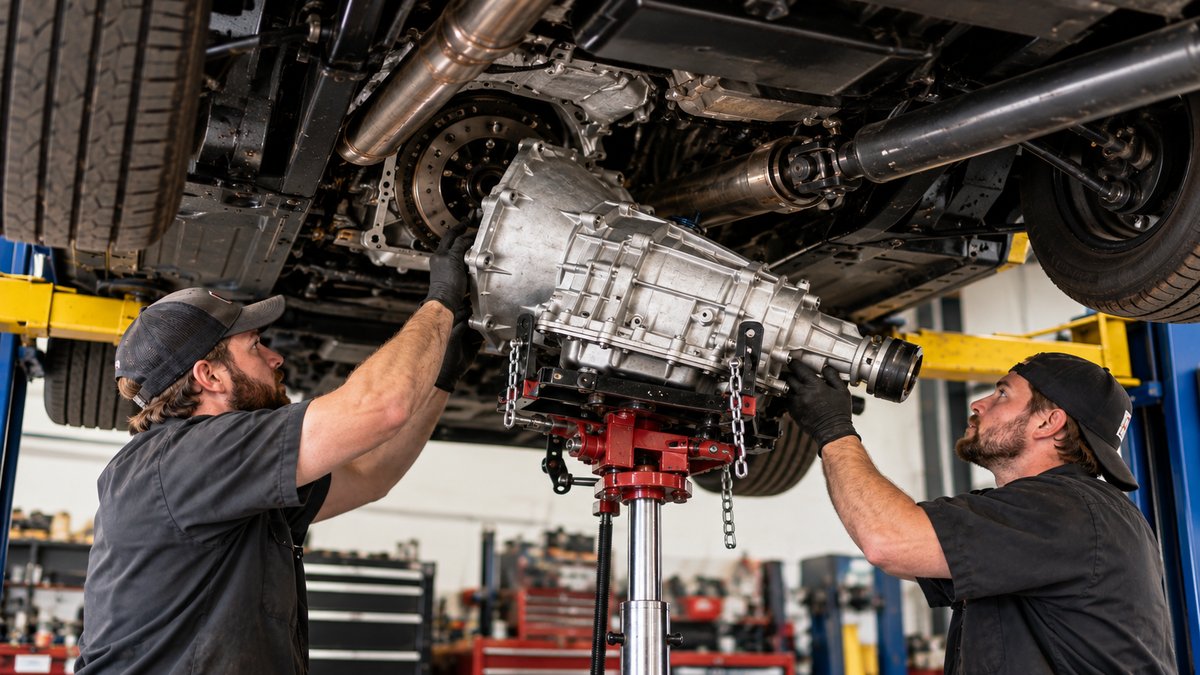
How Much Does It Cost to Replace a Transmission? What a Built Car Actually Pays
A transmission replacement runs from about $2,500 to more than $12,000. Where you...