
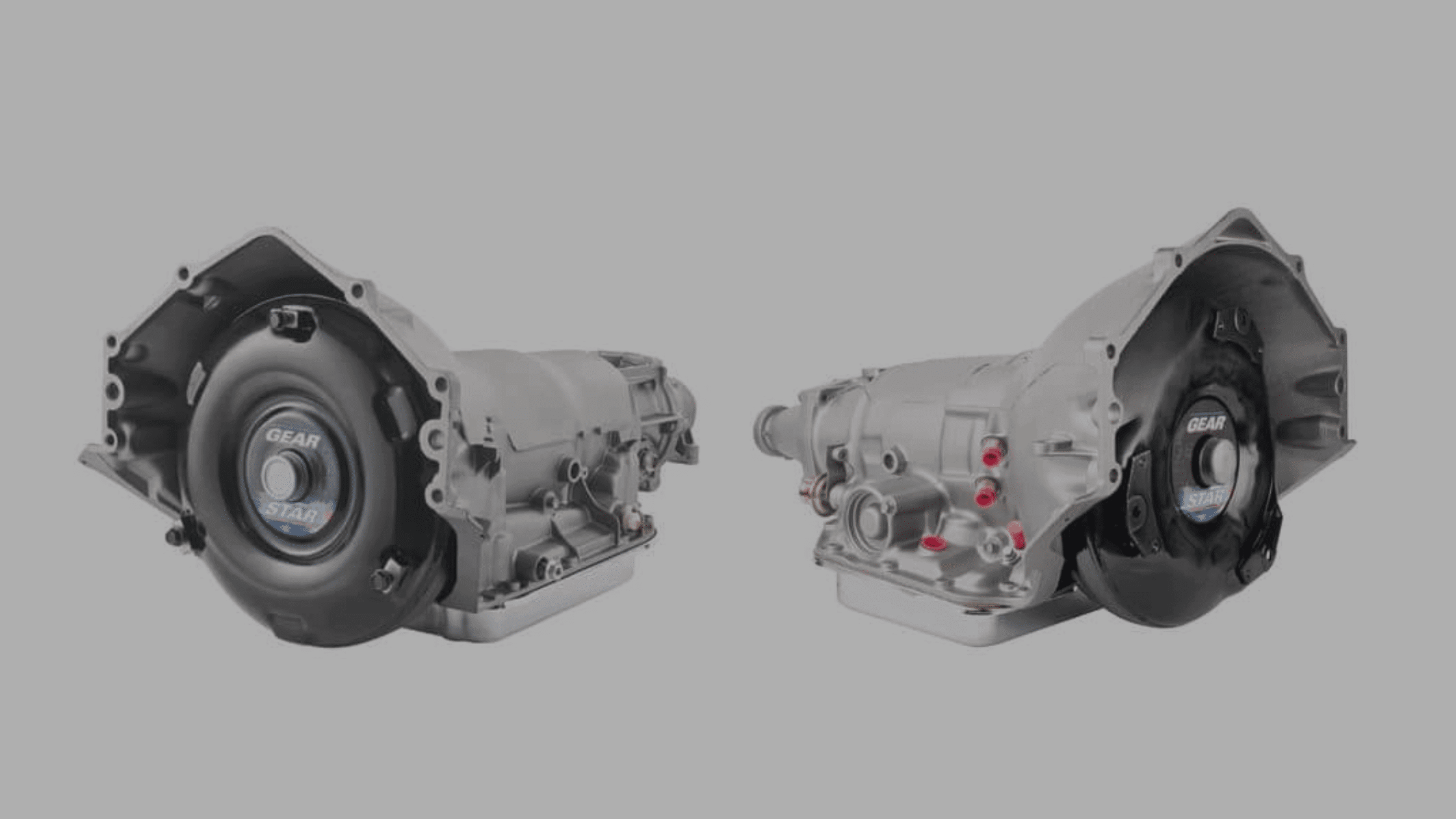
TH350 vs. TH400 Performance: Which Transmission Offers Better Power and Reliability?
Overview: TH350 vs TH400 Transmission
The TH400 holds more power. The TH350 is lighter and shorter. That is the whole comparison in two sentences, and everything else is about matching one of them to your engine, your chassis, and the way you actually drive the car.
Both are GM three speed automatics from the Turbo Hydramatic family. The TH400 came first, in 1964, built for high torque cars and trucks. The TH350 followed in 1969 as a lighter, more compact unit for lower torque applications. The TH400 uses an aluminum case with a cast iron center support section and an integral bell. The TH350 case is aluminum, which is a large part of why it weighs less.
Here is the short answer by combination. Small block making 300 to 500 hp in a street car or a light street rod: build a TH350. Big block, a boosted or nitrous small block, or anything living past roughly 550 hp: build a TH400. Heavy vehicle, truck, or tow rig: TH400 regardless of power level. If you need overdrive for highway rpm, neither one is the answer and you should be looking at a 700R4 instead.
A Brief Look at the Hydramatic Series
The Hydramatic arrived in 1939 from Oldsmobile, and it was the first mass produced automatic transmission in the world. The original was a four speed with a dual range design. During World War II it went into military vehicles, and the durability lessons from that work fed straight back into passenger car development.
The Turbo Hydramatic series showed up in the 1960s and replaced the earlier Hydramatic units along with Dynaflow and the two speed Powerglide. The TH400 in 1964 was the heavy duty end of that line and got a reputation for strength in trucks and performance cars. The TH350 in 1969 covered the lighter end, and it became the default in mid size and smaller GM cars.
Both were phased out as fuel economy rules pushed GM toward overdrive automatics. Neither ever left the performance world. They are still the two most swapped GM automatics in the hobby, and shops like Gearstar still build both from bare cases. Our full GM transmission lineup covers both units plus the overdrive replacements.
Power, Torque, and Gear Ratios Capabilities
The TH400 is the stronger unit and it is not close. Larger clutch packs, larger diameter drums, heavier planetary carriers, a stouter input shaft, and a 32 spline output shaft. The TH350 uses a 27 spline output shaft, and that spline count is the fastest way to tell the two apart when the trans is out of the car.
Commonly cited stock capacity is around 450 lb-ft of input torque for the TH400 and roughly 350 to 400 lb-ft for the TH350. Those are stock numbers on stock parts, and neither one describes a built unit. A performance TH350 with a hardened sun shell, an upgraded direct drum, a heavy duty servo, and a recalibrated valve body lives well past its factory rating behind a strong small block. A TH400 with a manual valve body, billet input, and a race clutch pack is a proven 1,000 hp class transmission and has been the default automatic in Pro Street and Pro Mod cars for decades.
Ratios are close enough that they rarely decide the build.
Spec | TH350 | TH400 |
First gear | 2.52:1 | 2.48:1 |
Second gear | 1.52:1 | 1.48:1 |
Third gear | 1.00:1 | 1.00:1 |
Output shaft | 27 spline | 32 spline |
Typical dry weight | About 120 lb | About 135 to 145 lb |
Stock torque, commonly cited | Roughly 350 to 400 lb-ft | Around 450 lb-ft |
The TH350 first gear is numerically slightly deeper, which helps initial acceleration a hair.
Line pressure is the lever most people ignore. Raising line pressure through the valve body and the pump reduces clutch slip under load and is a large part of why a built unit survives power that would cook a stock one. It also loads the pump harder, which is why a TH400 running high line pressure wants a fresh pump and a good cooler.
Weight and Performance: Why It Matters
The TH350 is about 20 lb lighter dry and a good deal lighter filled, because the TH400 holds more fluid. It is also about 3 inches shorter overall, and more than that if you are comparing against a long tail TH400.
That matters in three places. Rotational and total mass in a light drag car, where 20 lb behind the engine is real. Driveshaft length and tunnel clearance on a swap, where 3 inches decides whether you are cutting a floor.
In a big block full size car, a truck, or a tow rig, the weight difference is noise and the strength difference is everything. Run the TH400.
Bellhousing, Spline Count, and Swap Fitment
Both units use a case with the bell integrated, so you do not swap bellhousings on either one. What changes is the bolt pattern family cast into the case.
Bolt patterns
The TH350 was built primarily in the Chevy pattern, with a BOP pattern version for Buick, Oldsmobile, and Pontiac engines. The TH400 came in Chevy pattern, BOP pattern, and a Cadillac specific pattern on Cadillac big block cars. Some early TH400s also locate the starter differently. Confirm the pattern by casting number before you set the engine in the car, not after.
Output shaft and driveshaft
The 27 spline TH350 and 32 spline TH400 output shafts take different yokes. If you are converting from one to the other, budget for a yoke and a driveshaft that is cut and balanced to the new length.
Converter and flexplate
The two units do not share converters. The TH400 converter is physically larger and heavier and mounts to a different pattern. Vintage TH400 hunters look for the Switch-Pitch, a variable pitch stator converter used on some mid 1960s units that changes stall on the fly. Later TH350s built between 1979 and 1984 got a lock up converter, and units after that used an electronically controlled lock up for fuel economy. A lock up TH350 needs the matching converter and control setup, so identify what you have before ordering parts. If you want the shop to spec the converter with the build, start from the TH350 build page or the TH400 build page.
Stall speed selection follows the engine, not the transmission. A mild small block street car typically wants something in the 2,000 to 2,500 stall range. A warmed up 383 or 406 usually lands closer to 2,800 to 3,200. A pump gas big block often runs 2,400 to 2,800. A boosted or nitrous car frequently wants 3,500 to 4,500. Treat the transmission and the converter as one system. Speccing one without the other is how a good build ends up slipping.
Rebuilding, Shift Kits, and Longevity Considerations
Parts support on both is excellent. Cases, pumps, planetaries, drums, clutch packs, bands, and valve bodies are all available new. TH400 heavy duty parts, billet input shafts, race sun shells, and transbrake valve bodies generally cost more than the TH350 equivalents because they are built to hold more torque.
Shift kits and valve body work do two things. They firm up and speed up the shift, which reduces the time the clutches spend slipping, and they let you choose between an automatic shift pattern and full manual control. A street car usually wants a firm automatic calibration. A strip car wants a manual valve body, and often a transbrake.
Longevity favors the TH400. A healthy TH400 in a well cooled application will run well over 200,000 miles, including behind big block engines. The TH350 is durable within its power band, but it has less margin, so cooling and fluid discipline matter more.
Failure modes differ. TH350 problems usually trace to the direct clutch drum, the sun shell, or the intermediate band under repeated abuse. TH400 problems take longer to show up and usually land on the intermediate sprag, the front pump under sustained high line pressure, or a cracked case under transbrake launches. Both are preventable with better parts up front.
Diagnostic sequence when one is acting up
Check fluid level and condition first. Burnt smell or dark fluid means clutch material is already circulating. Then check the cooler lines and the operating temperature, because heat is the root cause behind most of what follows. Then check throttle valve linkage or cable adjustment, since a misadjusted TV setup on a TH350 causes late or harsh shifts and will burn the unit down. Then check the vacuum modulator and its line for leaks. Then pull the pan and inspect the filter and the debris in it. Only after that does it make sense to talk about a teardown.
Symptom | Most likely cause |
Slips in third only | Direct clutch or sun shell |
No reverse, second gear only | Broken sun shell |
Harsh or late shifts | TV cable or modulator adjustment |
Delayed engagement when cold | Worn pump or low line pressure |
Loses drive after a hard launch | Intermediate sprag on a TH400 |
Suitability for Daily Driving vs Heavy-Duty Use and Drag Racing
For a street car that gets driven, the TH350 is the easier unit to live with. Less mass to spin, less fluid to heat, and a shorter case that fits without cutting anything. Behind a healthy small block it does the job.
For heavy duty use, the TH400 is the right call. Weight, towing, sustained load, and big block torque are exactly what it was designed for. On a daily driven light car it is more transmission than the job needs.
For drag racing, it depends on power. A built TH350 with a transbrake valve body is a competitive combination behind a small block and saves weight. Past the small block ceiling, or with boost or nitrous, the TH400 is what survives slick tire launches and repeated wide open throttle passes.
Neither one has overdrive, so highway rpm is a rear gear conversation. At 65 mph on a 26 inch tire, expect roughly 2,300 rpm with a 3.08 gear, about 2,550 with a 3.42, about 2,780 with a 3.73, and about 3,050 with a 4.10. Keep a highway cruiser in the 3.08 to 3.42 range. If you want lower cruise rpm than that with the same acceleration, the answer is an overdrive unit from the Gearstar transmission lineup, not a different three speed.
Which Transmission Offers Better Power and Reliability?
The TH400 offers more power capacity and more reliability margin. The TH350 offers better packaging and lower weight, and it is reliable within its band. Neither one wins on paper because they were not built for the same job.
Build a TH350 if you are running a small block in the 300 to 500 hp range, if weight and length matter, or if the car is a street driven muscle car or street rod. Build a TH400 if you are running a big block or a boosted small block, if the car sees brake torque or transbrake launches, if the vehicle is heavy, or if you want headroom for power you have not added yet.
Gearstar builds custom TH350 and TH400 transmissions to your combination, with the valve body calibrated for your use and a torque converter matched to your engine. One builder per unit, start to finish, and every transmission is dyno tested before it ships. Call 330-434-5216 to spec your build.
More From the Shop
What is the Difference Between a 4L70-E and a 4L75E? Key Variations Explained
The 4L70-E and 4L75-E transmissions are both upgrades of the 4L60 series, but they...
Are 4L60E and 4L65E Interchangeable? Understanding the Differences and Compatibility
Physically, yes. The 4L60E and 4L65E share the same case, the same bellhousing bolt...
TH400 vs 4L80E vs 6L80E: Which GM Heavy Duty Automatic Belongs Behind Your Build?
All three of these will hold serious power. The question is not which one is...