
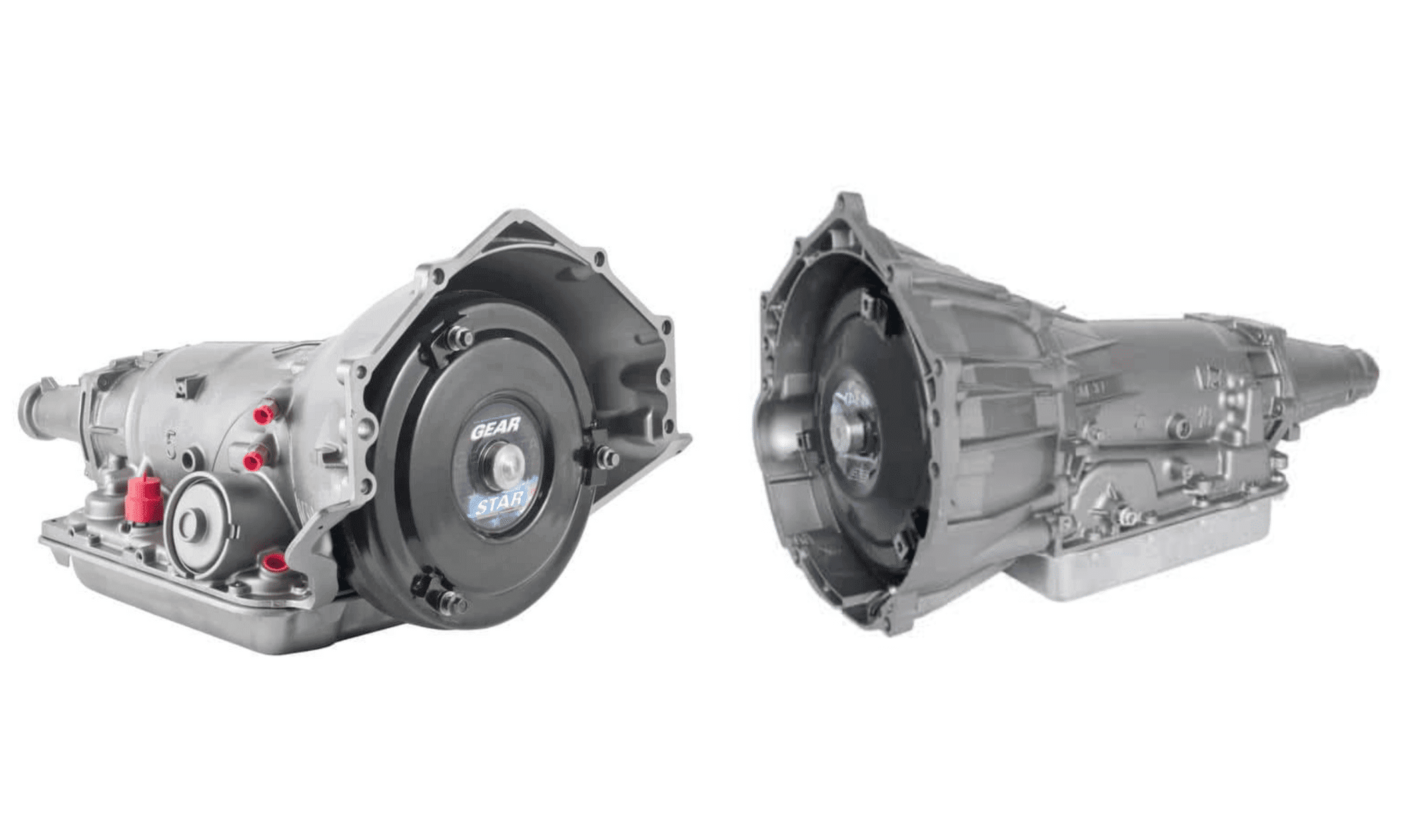
Are 4L60E and 4L65E Interchangeable? Understanding the Differences and Compatibility
Physically, yes. The 4L60E and 4L65E share the same case, the same bellhousing bolt pattern, the same mount location, the same tailhousing, the same cooler line fittings, and the same torque converter bolt pattern and input spline count. On almost every rear wheel drive GM chassis that came with one, the other bolts in.
Electronically, it depends on the chassis and the year. Both are computer controlled. The shift calibration and the solenoid command tables that the factory wrote for a 4L60E are not always the tables a 4L65E wants. On some combinations the swap drives fine. On others you get a harsh 1 to 2 or a lazy 3 to 4 until the controller is reflashed.
There is a third answer that most people miss. You can build the 4L60E already in the car to 4L65E internal spec. Same case, same install, same controller, better guts.
What Are the 4L60E and 4L65E Transmissions?
Overview of the 4L60E Transmission
The 4L60E is GM's electronically controlled four speed automatic. It arrived in 1993 as the electronic successor to the 700R4, which GM also called the 4L60. It ran behind most of GM's rear wheel drive lineup through the 1990s and into the 2000s. Fourth generation Camaros and Firebirds, C4 and C5 Corvettes, S10s and Blazers, full size trucks, the Yukon, and the Tahoe all used it.
That volume is why the 4L60E is the single most common unit on a transmission shop bench. Cores are everywhere, parts are everywhere, and every failure mode is documented.
The 4L65E: An Enhanced Version
GM introduced the 4L65E in 2001 as the heavy duty version of the same platform. Same case, stronger internals. It went into vehicles that made more torque or carried more weight than the base 4L60E was designed for: the Silverado SS, the Trailblazer SS, the mid 2000s Cadillac Escalade, and the Hummer H2.
Nothing about the 4L65E is a new architecture. It is a 4L60E with better parts in the places the 4L60E gives up.
Key Differences Between the 4L60E and 4L65E
Internal Components and Durability
Three changes carry most of the difference between the 4L60E and the 4L65E.
Five pinion planetary carriers where the 4L60E used four pinion carriers
A hardened, stronger input shaft
Improved clutch packs and steels
Those changes matter under load. A five pinion carrier spreads torque across more teeth, which cuts the shock the sun gear sees on a hard shift and lets the unit hold higher input torque without scattering a planetary. The stronger input shaft addresses the other classic failure, a shaft twisted off at the drum splines.
The useful part for a builder is that all three are available as rebuild parts. A 4L60E can be built to 4L65E internal spec, or well past it, inside its original case. The job is not purely a parts swap. Doing it correctly means a new planetary gear set, the stronger input shaft, better clutches and bands, and appropriate modifications to the separator plate so fluid routing matches the new stack. Skip the separator plate work and the shift quality never comes right.
Torque Capacity
Published stock ratings put the 4L60E near 360 lb-ft of input torque and the 4L65E near 380 lb-ft. On paper that gap is small. In the shop the gap is bigger than the numbers suggest, because the 4L65E holds its rating through a longer duty cycle. The four pinion carrier in a 4L60E fatigues faster under repeated full load shifts, so the 4L60E tends to fail at its rating rather than live at it.
Either unit built to performance spec with five pinion carriers, a billet input shaft, upgraded clutches, and a calibrated valve body clears both stock numbers by a wide margin. Stock ratings tell you where the factory parts stop, not where the platform stops. Treat the published numbers as a floor for a healthy stock unit on stock fluid and stock cooling, and expect less from a high mileage core.
Bolt Pattern and Torque Converter Compatibility
The bellhousing bolt pattern, the converter bolt pattern, and the input spline count are the same on both units. A converter built for a 4L60E fits a 4L65E and the reverse is also true. That does not mean you should reuse it. A stock converter behind a built trans is the weak link, and stall speed needs to match the engine's torque curve, not the case it bolts to. Spec the converter with the build, not after it. One note on sourcing: converter product pages linked from this site can send you to a separate brand site, so if you want a converter matched to a Gearstar unit, ask for it as part of the build rather than ordering it on its own. Start from the full transmission catalog if you are still deciding on a platform.
What Has to Match Electronically on a 4L60E to 4L65E Swap?
Three things have to line up: the connector and wiring, the solenoid command strategy, and the shift calibration.
The connector and pin count are consistent within a given generation, so wiring is rarely the problem. Solenoid control is. The computer is commanding pressure control, shift solenoids, and the TCC solenoid on a schedule written for a specific unit. If the schedule is wrong you get either a hard bang or a slip, and sometimes you get codes for a component that is perfectly healthy.
Work it in this order.
Scan for stored codes before you assume anything mechanical. A pressure control solenoid code after a swap is usually calibration, not hardware.
Check line pressure at idle and at wide open throttle against the factory spec for the chassis, not the donor.
Drive it and log the 1 to 2 and 3 to 4 shifts. Note whether the complaint is timing, firmness, or both.
If timing is wrong, reflash the controller to a calibration written for the 4L65E. If firmness alone is wrong, the valve body and accumulator setup is where to look.
On a standalone controller, spec the tune for 4L65E internals up front and none of this debug happens.
Vehicle Applications for the 4L60E and 4L65E
Knowing which platform came with which unit saves you money when you source a core.
The 4L60E covers 1993 to 2002 Camaro and Firebird in V6 and V8, C4 and C5 Corvette in the earlier years, 1996 to 1999 full size trucks and SUVs including Silverado, Tahoe, and Yukon, the S10, Sonoma, Blazer, and Jimmy through the mid 2000s, and base rear wheel drive Silverado and Sierra from 2003 forward.
The 4L65E shows up in the 2001 to 2007 Silverado SS and Sierra Denali, the 2003 to 2009 Trailblazer SS and Envoy XL, the mid 2000s Cadillac Escalade, and the 2002 to 2009 Hummer H2.
Those 4L65E platforms were lower volume, so 4L65E cores are harder to find and cost more when you find one. That alone pushes a lot of builders toward rebuilding the 4L60E they already have. If the power level is past what either unit should hold, step up to a 4L80E instead of chasing parts.
Common 4L60E Failure Modes and What Causes Them
The 4L65E internals exist because the 4L60E fails in predictable places. Use the symptom to find the part.
Symptom | Likely cause |
No 2nd or 4th gear, engine flares | Split stamped steel sun shell at the splines |
Slipping in 3rd and 4th under throttle | Glazed or burnt 3 to 4 clutch pack |
No reverse, no 2nd gear | Stripped reverse input drum splines |
Delayed engagement, general slipping | Worn pump, low line pressure |
Harsh or flaring 1 to 2 shift | Tired 2 to 4 band, worn valve body bores |
Every part on that list has a stronger aftermarket replacement, and a performance build sheet replaces all of them at once rather than waiting for the next one to fail.
When Should You Upgrade to a 4L65E?
Power Upgrades and Heavy-Duty Use
Upgrade when the engine is making torque the stock unit was not designed to pass. Cammed LS builds, boost on an otherwise stock long block, and trucks that tow at weight are the honest cases. Around the 500 lb-ft mark, shop experience says stock 4L60E internals stop being a question of if and become a question of when.
A worn 4L60E also announces itself. The harsh 1 to 2 shift the platform is known for comes from worn valve body bores and a tired 2 to 4 band, not from anything you can tune away. Rebuilding with 4L65E spec internals and a calibrated valve body fixes the cause.
Longevity and Reliability
For a stock daily driver with stock power, a healthy 4L60E is enough. For anything that sees track days, drag passes, sustained towing, or forced induction, the five pinion carriers, the hardened input shaft, and a valve body calibrated to the build are what survive the season. Browse the full GM transmission lineup to see where each platform lands.
Rebuild the 4L60E or Swap in a 4L65E?
A used 4L65E is fast. It is also an unknown. You get whatever mileage and abuse the donor had, you may still need a reflash, and the guarantee is whatever the yard offers.
A rebuild keeps the case in the car and replaces the parts that fail: new clutches and bands, five pinion planetaries, a billet input shaft, a calibrated valve body, corrected separator plate, and fresh fluid. You know exactly what is inside it and you can spec it to the power level the engine actually makes.
For most builds, the rebuild wins on known condition and on control over spec. It also comes with real coverage on parts and workmanship, which a junkyard unit does not.
Cooling and Fluid
Heat kills both units. Stock cooling is marginal behind a stock engine and inadequate behind a built one. Any 4L60E or 4L65E living behind a performance engine wants an auxiliary cooler sized to vehicle weight and duty cycle. Published guidance is to keep fluid at or below roughly 200 degrees F under sustained load, and to treat 220 degrees F as the point where fluid life drops off sharply.
Fluid spec is simple. GM originally called for Dexron III on the 4L60E and later moved to Dexron VI, which is backward compatible and holds up better under heat. For a performance rebuild running higher line pressure, use a quality synthetic meeting or exceeding Dexron VI.
Bottom Line
The 4L60E and 4L65E interchange physically across the case, bellhousing, mount, and cooler lines. The controller is the variable, and on some chassis it needs a reflash. If you want 4L65E strength without touching the controller, build the 4L60E you already have to that spec or past it.
Every Gearstar performance transmission is built by one builder, assembled to your engine and your use case, and dyno tested before it ships. Matched converters are specified with the build. Call Gearstar at 330-434-5216 to spec a 4L60E or 4L65E build for your car, your engine, and how you drive.
More From the Shop
What is the Difference Between a 4L70-E and a 4L75E? Key Variations Explained
The 4L70-E and 4L75-E transmissions are both upgrades of the 4L60 series, but they...
TH350 vs. TH400 Performance: Which Transmission Offers Better Power and Reliability?
The TH400 holds more power. The TH350 is lighter and shorter. That is the whole...
TH400 vs 4L80E vs 6L80E: Which GM Heavy Duty Automatic Belongs Behind Your Build?
All three of these will hold serious power. The question is not which one is...