
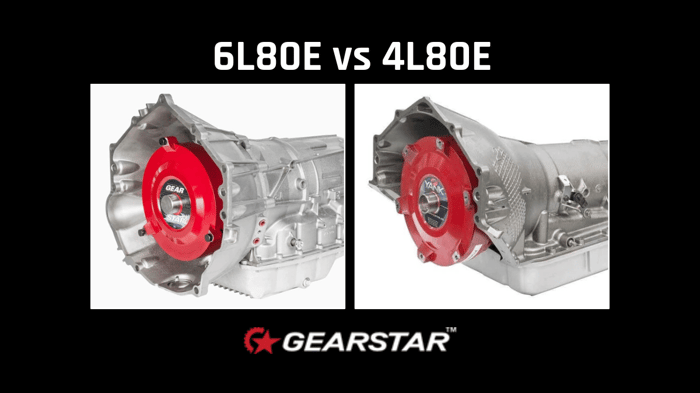
6L80E vs 4L80E: Which Transmission Is Better for Your Performance Build?
The 6L80E vs 4L80E discussion has been around for years and isn’t going anywhere. Both transmissions come from GM’s engineering pipeline, both have powered serious builds, and both have earned their place in performance circles. The debate usually shows up when builders start pushing past stock power levels or planning a swap that blends old-school strength with modern drivability.
On paper, one is newer and more refined, the other is older and battle-tested. That alone doesn’t settle anything. The real decision sits in how the vehicle will be used, how much power it will see, and what kind of driving experience is expected when the throttle goes down.
Modern efficiency versus proven durability is the simplest way to frame it, but even that doesn’t capture all the nuance. Each transmission was built for a different era of performance thinking, and that difference shows up everywhere from gearing to electronics.
Understanding the Basics of Each Transmission
What Is the 4L80E?
The 4L80 transmission traces its roots back to the TH400, one of GM’s most respected heavy-duty automatics. That foundation explains a lot about why the transmission behaves the way it does under stress.
It’s a 4-speed automatic with electronic control layered onto a proven heavy-duty platform. The architecture was designed for trucks, commercial applications, and high-load environments where long-term durability mattered more than refinement.
In performance use, the 4L80E became a favorite for drag racing, turbocharged setups, and high-displacement engines. Builders tend to trust it because the platform responds well to performance upgrades and has decades of proven success in high-horsepower applications.
What Is the 6L80E?
The 6L80E transmission came along as part of GM’s shift toward modern drivetrains. It introduced two additional gears, tighter ratio spacing, and a stronger focus on efficiency and refinement.
It’s found in newer GM trucks, performance cars, and SUVs, where drivability and fuel economy matter just as much as performance output. The driving experience feels more current, especially in mixed street and highway use.
That refinement comes with complexity. Internally and electronically, it’s more advanced, which means tuning and integration matter far more than they do with older platforms.
Gear Ratios and Performance Behavior
4L80E Gear Ratios and Driving Characteristics
The 4L80E uses wider gear spacing, which creates a more traditional performance feel. Shifts are noticeable, and the engine tends to sit in larger RPM drops between gears.
That can feel less refined in everyday driving, but under load, it delivers a very direct connection between throttle input and vehicle response. There is less shifting activity overall, especially under sustained acceleration.
For builders who want consistency and mechanical predictability, that behavior is part of the appeal.
6L80E Gear Ratios and Driving Characteristics
The 6L80E tightens those gaps significantly. With six forward gears and a much deeper first gear ratio, the engine stays closer to its power band more often, which improves launch feel, acceleration smoothness, and overall responsiveness.
That lower first gear can make heavier vehicles feel more aggressive off the line while also allowing more flexibility in rear gear selection. On the highway, the added overdrive gearing keeps RPMs lower, which helps efficiency and reduces long-distance strain.
Shifting is more frequent but also more refined. It feels less like discrete gear changes and more like continuous acceleration in many situations.
Strength and Power Handling
4L80E Strength and Power Handling
Durability is where the 4L80E built its reputation. The internal components are heavy-duty by design, and the transmission has been proven in high-horsepower environments for decades.
Compared to many factory automatic transmissions, the 4L80E typically requires fewer upgrades to support serious power reliably. That’s one reason performance builders continue to rely on it for turbocharged engines, nitrous combinations, towing applications, and heavy vehicles that make substantial torque.
At extreme power levels, though, build quality still matters. Input shafts, clutch capacity, valve body calibration, cooling, and converter selection all become increasingly important as horsepower climbs.
That’s where purpose-built performance versions, like professionally upgraded 4L80 transmissions, separate themselves from stock or lightly refreshed units. The platform is strong from the start, but long-term reliability under aggressive use still depends on how the transmission is built and calibrated.
6L80E Strength and Power Handling
The 6L80E is strong, but its strength is more conditional. At stock and moderate power levels, it performs well and delivers excellent drivability.
As power levels increase, tuning quality, clutch capacity, converter setup, and thermal management become far more important to long-term reliability. The transmission’s tighter tolerances and more advanced control strategy leave less room for incomplete calibration or inconsistent setup.
In aggressive performance applications, especially with heavier vehicles or forced induction, professionally built versions with upgraded internals become increasingly important.
Electronics and Control Complexity
4L80E Electronics and Control Complexity
The 4L80E integrates more easily into older platforms. It works well with standalone controllers and doesn’t rely heavily on adaptive behavior.
That simplicity makes it popular for restomods and classic builds where modern electronics are not part of the original design, as fewer variables mean fewer points of failure in many swap scenarios.
6L80E Electronics and Control Complexity
The 6L80E relies heavily on electronic control and ECU integration. Adaptive shifting strategies help optimize drivability, but they also introduce tuning complexity.
Proper calibration becomes critical, especially in performance applications. Without it, shift quality and reliability can suffer. It rewards careful setup, but it’s less forgiving of incomplete integration.
Efficiency, Drivability, and Real-World Use
Street and Highway Behavior of the 4L80E
On the street, the 4L80E feels solid and straightforward. It’s reliable under load but not particularly refined in terms of cruising efficiency.
RPMs tend to sit higher at highway speeds compared to newer transmissions. That tradeoff is part of its older design philosophy. It still performs well, but it doesn’t prioritize comfort or fuel economy.
Street and Highway Behavior of the 6L80E
The 6L80E is more comfortable in daily-driven performance builds. Lower cruising RPM and smoother shifting make it better suited for mixed use.
It handles traffic, highway driving, and performance pulls with a more modern feel. For vehicles that spend time outside of the strip or track, that balance can be important.
Weight, Size, and Swap Considerations
4L80E Weight, Size, and Swap Considerations
The 4L80E is a large, heavy transmission. That size reflects its heavy-duty origins, but it can create packaging challenges in smaller chassis.
Driveline support components often need to be matched accordingly, especially in tighter builds.
It’s common in trucks and larger platforms where space isn’t a constraint.
6L80E Weight, Size, and Swap Considerations
The 6L80E can offer packaging advantages in some modern chassis, but fitment varies considerably depending on the platform. In swap situations where a 4L60 or 4L80 is being replaced, the transmission tunnel will need to be cut and a new one fabricated to accommodate the 6L80E's dimensions.
Its integrated bellhousing design and electronic requirements can still create swap challenges, particularly in older vehicles using standalone engine management or limited transmission tunnel space.
In many builds, physical fitment becomes manageable long before electrical integration and tuning are fully sorted out.
Common Build Scenarios: Which One Fits Best?
High-horsepower drag or turbo applications tend to favor the 4L80E. Its durability under repeated stress makes it a reliable choice when power levels are aggressive.
Restomod and modern street builds often lean toward the 6L80E. The added gears and drivability improvements match well with mixed-use vehicles that still want performance capability.
Towing and dual-purpose setups sit somewhere in between. Strength favors the 4L80E, but efficiency and comfort lean toward the 6L80E. The decision usually comes down to how often the vehicle sees a sustained load versus daily driving.
Cost, Availability, and Long-Term Ownership
Availability plays a role in both platforms. The 4L80E benefits from widespread use and a strong rebuild ecosystem. Parts are familiar, and rebuild paths are well established.
The 6L80E also has strong aftermarket support, but its complexity can increase rebuild cost and diagnostic time.
Long-term ownership comes down to serviceability. Simpler systems tend to be easier to maintain, while modern systems demand more precise tuning and diagnostic capability.
Final Comparison: 6L80E vs 4L80E in Real Terms
There is no universal winner between the 6L80E vs 4L80E. Each transmission serves a different kind of build philosophy. One prioritizes strength, mechanical simplicity, and proven performance under extreme load. The other focuses on efficiency, drivability, and modern shifting behavior.
When picking between the two, engine combination, vehicle weight, intended use, and power goals matter more than the badge on the case. Matching the transmission to the build is where reliability and performance actually come together.
Gearstar Performance Transmissions works directly with builders to help match the right transmission to the application, taking into account power level, vehicle weight, gearing, and intended use so the setup is aligned before anything is built. Get in touch with our team today to speak with one of our techs or get an estimate for a custom-built performance transmission.
More From the Shop
Which is better, 200R4 or 700R4?
The 200R4 vs 700R4 debate has been going on for decades, and for good reason. Both...
6L80 Transmission 4x4 vs 6L80 Transmission 2WD: What’s The Difference
If you've spent any time planning a late-model GM swap or sourcing a replacement...
700R4 vs 4L60E: What To Know Before Upgrading
When it comes to GM overdrive automatics, few transmissions get talked about more...