
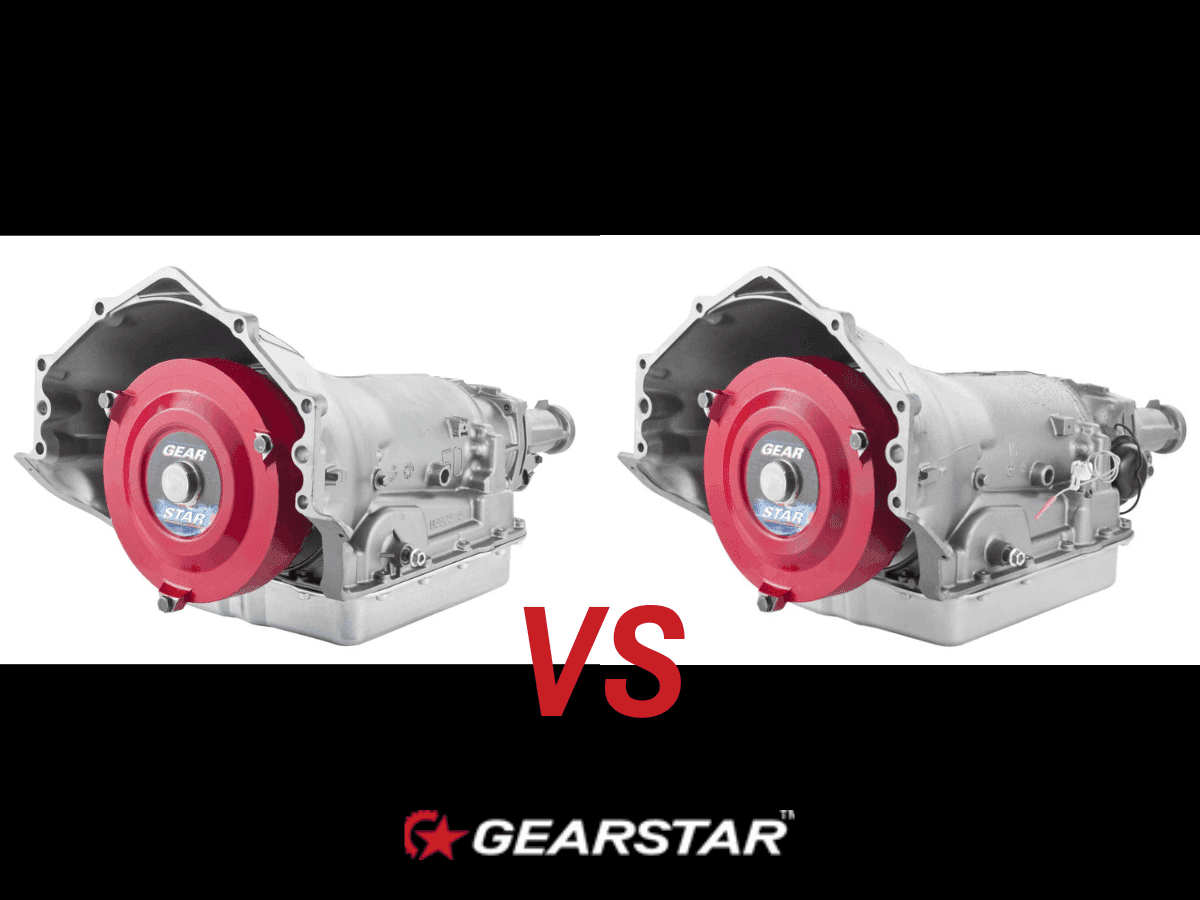
700R4 vs 4L60E: What To Know Before Upgrading
When it comes to GM overdrive automatics, few transmissions get talked about more than the 700R4 and the 4L60E. Both have proven themselves in everything from daily drivers to serious street builds. They strike a balance between performance, drivability, and highway-friendly gearing that older three-speed transmissions simply cannot match. Understanding the difference between 700R4 and 4L60E models is crucial when upgrading or swapping transmissions.
At a glance, they look nearly identical, and in many ways, they are. The 4L60E is essentially the next step in the evolution of the 700R4. But once you get beyond the surface, especially when you are planning a swap or an upgrade, the differences start to matter quite a bit.
So how do you decide which one actually fits your build? Let's explore the 700R4 transmission vs. the 4L60E transmission to help you make the right choice.
The History of the 700R4 and 4L60E
To understand the differences between these transmissions, it helps to know how we got here.
Back in 1982, GM introduced the 700R4 transmission as a replacement for the TH350. The goal was simple. Improve fuel economy without sacrificing drivability. The addition of overdrive and a deep first gear made a noticeable difference right away.
By the early 1990s, GM started standardizing its transmission naming. The 700R4 became the 4L60, which stood for four forward gears, longitudinal layout, and a torque rating designation. Internally, not much changed at that point.
Then came 1993 and the introduction of the 4L60E transmission. Instead of relying on hydraulic controls, GM moved to electronically managed shifting, allowing for better precision, improved fuel economy, and smoother operation.
The Key Difference Between 700R4 and 4L60E: Hydraulic vs Electronic Control
If there is one difference between these two transmissions that matters more than anything else, this is it.
The 700R4 is a fully hydraulic transmission.
It uses a throttle valve (TV) cable to control line pressure and shift timing. You can think of this as the heart or life line of your transmission. When it is properly adjusted, it works well and delivers consistent performance. But it is not very forgiving. If the TV cable is off, even slightly, you can run into poor shifting, or it can very quickly cause severe damage to your transmission.
The 4L60E, on the other hand, is electronically controlled.
There is no TV cable. Instead, it relies on sensor inputs and commands from a computer. Shift timing, firmness, and behavior can all be adjusted through tuning.
Gear Ratios and Performance Characteristics
Here is where things get interesting. Both transmissions utilize identical gear ratios: a deep 3.06:1 first gear and a 0.70:1 fourth-gear overdrive.
That 3.06 first gear gives strong off-the-line acceleration. In lighter vehicles or anything with decent torque, it is a noticeable improvement over older transmissions like the TH350 or TH400.
Then there is the 0.70 overdrive. That keeps engine RPM down on the highway, which improves fuel economy and reduces wear. For anything that sees regular street use, that matters.
Since the ratios are identical, performance differences do not come from gearing. Instead, they come from how the transmission is controlled and how well it is matched to the rest of the build.
Installation and Swap Considerations
From an installation standpoint, the 700R4 is the simpler option. No electronics means fewer parts, less wiring, and fewer things to troubleshoot. For classic cars with carbureted engines, that simplicity is often the deciding factor.
The 4L60E adds more steps. Because it’s electronically controlled, you’ll need a wiring harness and a transmission control unit (TCU), along with proper tuning. For some builders, that is no problem. For others, it adds time, cost, and complexity that may not be necessary.
That said, going electronic opens up flexibility that the 700R4 simply can’t match. Even if you’re running a carbureted engine and want to eliminate the TV cable, a standalone transmission controller makes it possible to run a 4L60E without relying on engine electronics. With the right setup, the transmission can operate independently, regardless of how simple or complex the rest of the vehicle is.
The 4L60E also gives you full control over how the transmission behaves. Shift firmness, shift points, and line pressure can all be adjusted to match your driving style. Whether you want crisp, aggressive shifts or something smoother for cruising, the tuning is there to support it. And while that might sound complicated, systems like US Shift or PSI controllers are typically delivered pre-programmed with baseline settings—making the swap far more straightforward than many expect.
Physically, the two transmissions are very similar in size, and in many cases, they share the same overall length. However, differences can occur depending on the specific model, particularly in the output shaft and tail housing.
When planning a swap, these variations can affect driveshaft length, crossmember placement, and linkage setup. While many installations require little to no modification, it is important to verify fitment details ahead of time to avoid unexpected adjustments.
Strength, Reliability, and Upgrades
Both transmissions have seen major improvements over the years.
Early 700R4 units had known weaknesses, but later versions became much more reliable. The same goes for the 4L60E, which improved significantly over time as GM refined the design.
Still, in stock form, neither transmission is ideal for high-horsepower builds.
This is where build quality becomes critical. A properly built performance transmission, like the ones we produce at Gearstar, includes upgraded internals, stronger materials, and tighter assembly standards that increase durability and torque capacity, ensuring capability in demanding applications.
Cost Breakdown: 700R4 vs 4L60E
At first glance, the 700R4 often looks like the more affordable option.
The lack of electronics is what keeps the upfront cost lower. Core units are usually cheaper as well, though quality cores, especially the 1987 and newer auxiliary valve body versions that we use at Gearstar, are becoming harder to locate. These later units feature a larger input shaft and allow for valve body recalibration, which helps them handle more power. The 4L60E typically costs more up front, and between the transmission itself, controller, wiring, and tuning, expenses add up quickly.
But long-term value is not always the same as upfront cost.
A properly tuned 4L60E can improve drivability and efficiency. While a poorly adjusted 700R4, especially with an incorrect TV cable setup, can cause costly damage. So while the 700R4 may win on initial price, it does not always win on total cost of ownership.
Deciding which is the better long-term investment depends on your build and the type of maintenance you’re willing to do.
Which Transmission Is Right for Your Build?
Best for Classic Cars and Carbureted Setups
If you are working with an older carbureted vehicle, the 700R4 is hard to beat. It keeps things simple, avoids electronics, and delivers strong street performance with overdrive.
Best for Modern Engines and LS Swaps
For modern engines, especially LS platforms, the 4L60E is usually the better match. It integrates with the engine management system and allows everything to work together cleanly.
Best for Performance and High Horsepower Builds
At higher power levels, the choice is less about the model and more about how it is built.
Stock versions of either transmission will not hold up well under serious power. Upgraded internals and proper assembly are what matter most.
Best for Simplicity vs Tunability
If simplicity is the goal, the 700R4 wins. It is straightforward and easy to install.
If tunability is the goal, the 4L60E offers far more flexibility and control over shift behavior.
Final Thoughts: 700R4 vs 4L60E
There is no universal winner in the 700R4 transmission vs 4L60e transmission debate. Both have their place, and both perform well when matched to the right application.
The right choice between these GM transmissions depends on your build, your engine setup, and how the vehicle will actually be used. At the end of the day, the transmission you choose plays a major role in how your vehicle drives and feels.
If you’re looking for a high-performance transmission, Gearstar has you covered. If you need help picking the right option for your build, give our team a call, or if you’re ready to buy, get an estimate for a custom-built transmission.
Key Takeaways
- Choose the 700R4 when you want simplicity, standalone operation, or a carbureted build.
- Choose the 4L60E when precise electronic shift control and modern engine management matter.
- Incorrect TV cable adjustment is the single most common cause of premature 700R4 failure.
- The 4L60E requires proper wiring and tuning to function correctly.
- Remember the 4L60E vs 700R4 length differences when planning your swap.
More From the Shop
Is the Chevy 4L60E Transmission Good for Performance Builds?
Let’s discuss the Chevy 4L60E transmission for high-performance applications and...
4L80E Upgrades: Top Performance Parts to Boost Your Transmission
Discover essential 4L80E upgrades, including the Gearstar Billet Direct Drum with...
4L70E vs 4L60E: Specs, Internals, and Which One Your Build Actually Needs
The 4L60E and the 4L70E share gear ratios, a valve body layout that looks familiar,...