
Transmission Cooler Lines Replacement Cost, and When Patching Is a Waste of Money
Transmission Cooler Lines Replacement Cost, Line by Line
Transmission cooler lines replacement runs $150 to $450 per line for parts and labor, and $400 to $900 if both lines go or the trans has to come down partway for access. A spot repair with a barbed splice or a compression union runs $60 to $150 and it holds only when the rest of the tube is clean.
That is the whole answer. The part worth reading is which of those two you are actually looking at, because patching corroded steel moves the failure point a few inches down the tube and hands you the same repair next season. On a car with a built motor, a high stall converter, and a cooler you added on purpose, that leak is not a housekeeping item. It is the fluid level your clutch packs live on.
What the Cooler Circuit Is Doing
The pump pushes fluid out to the cooler and pulls it back through the return line, and that circuit runs every mile the car is in gear. Pressure in it is modest, generally under 60 psi at idle and higher under load, which is exactly why a weep never gets a rest. It is pressurized whenever the engine is running.
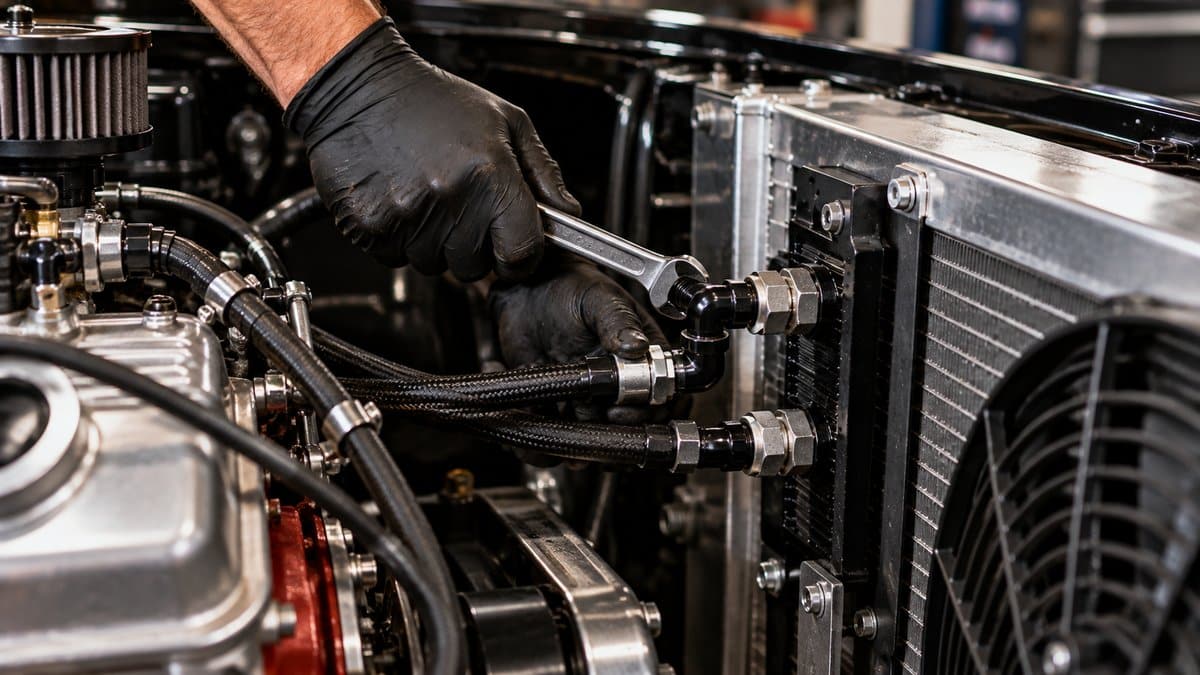
Factory lines are usually double wall steel, flared at the ends, sealed with a compression nut or a quick connect at the case, often with a rubber section where the driveline moves. Braided stainless with AN fittings handles vibration and heat cycling better, and it is the normal choice on a build, but it is not immune to bad routing or a fitting torqued by feel.
Heat is the reason any of it matters. Converter slip, clutch pack friction, and gear mesh all dump heat into the fluid, and if the circuit cannot reject it fast enough the fluid oxidizes and clutch material glazes. A car making repeated launches on a loose converter asks more of that circuit every pass than a stock truck asks of it in a year.
Signs the Lines Are Done
- Fluid spots under the front of the car, usually near the radiator support or where the line runs close to the frame
- Level dropping between checks with no other leak source you can find
- Burnt smell in the engine bay after a highway run
- Visible rust or pitting at bends, at clamps, or where the line passes the exhaust
- Wet, oily residue at a fitting, which means the flare or the crimp has started to give
- A hiss or a spray pattern with the engine running, which is an active failure, not a weep
Trace both lines end to end on a lift before you buy anything. A good share of leaks called in as cooler line problems turn out to be a pinhole in the cooler itself or a cracked case fitting. Wipe the run dry, run the engine, and let pressure show you the source.
Where They Actually Fail
- At the case fitting. These seal on an O-ring or a tapered seat, not on torque. Cranking one down for good measure cracks the boss or deforms the seal, which is how a shop creates the leak it was hired to fix.
- At the cooler tank connection. Crimped fittings corrode from the outside in, fast in salt states.
- At factory quick connects. Common on 2000s and newer GM and Ford applications. The internal O-ring hardens after ten or fifteen years and stops sealing while the spring clip still holds fine. They look perfect and leak anyway.
- Mid line near a header or a crossmember. Heat cycling fatigues the metal or cooks a rubber section. On a car with headers, a line routed two inches too close fails years early.
- At a bend radius. Engine movement plus an unsupported run starts a crack in the steel.
Why It Failed, Because That Decides the Fix
Corrosion is the leading cause on anything that sees road salt. Once you can see surface rust, wall thickness underneath is already compromised even where it is not leaking.
Vibration fatigue is the one people miss. Factory routing supports the line every few inches. Lose a clip, or leave one off after an unrelated repair, and that section flexes with every engine movement until the steel work hardens and cracks. That is the mystery leak that shows up months after somebody else's job.
Heat cycling kills rubber sections and quick connect O-rings. Hot to cold, every drive, for years, until the compound cracks or the seal loses its memory under pressure.
Overtightening cracks flares and fatigues threads. A flare seals on the angle, not on brute force.
Poor routing near heat is a build problem, not a wear problem. If a line failed early and the metal is discolored, fix the routing or you will replace it again.
Repair or Replace: Make the Call in One Table
| What you find | Root cause | The move |
|---|---|---|
| Single pinhole, tube clean and unpitted around it | Rock strike or isolated defect | Splice or compression union, $60 to $150 |
| Leak at a quick connect, tube end undamaged | Hardened O-ring | Replace the fitting or O-ring, permanent fix |
| Rust or pitting anywhere along the run | Corrosion | Full line replacement |
| Second leak within a few inches of an old patch | Corrosion you already paid to ignore | Full line, both sides if the other matches |
| Cracked at a bend, clip missing | Vibration fatigue | New line plus every bracket back in place |
| Leak plus a discolored line near headers | Routing | New line, rerouted with real clearance |
Two rules keep you out of the second bill. Judge the line on the condition of the whole run, not the spot that is wet today. And if it takes labor to reach, replace it, because a repair there means paying access twice.
Replacement, Start to Finish
- Trace both lines on a lift with the run wiped dry and the engine running, so pressure finds the source instead of your flashlight.
- Contain fluid at the disconnect points. The cooler holds more than people expect.
- Disconnect at the case and at the cooler. Quick connects need the correct release tool for that size. Prying cracks the fitting or scores the tube end.
- Note routing, brackets, and clips as the old line comes out.
- Install the new line, OEM style steel, pre bent, or braided stainless with AN fittings. Every clip goes back in its original position. Skipping one starts the next fatigue crack.
- Torque fittings to spec with a wrench.
- Refill and check level with the engine running and the trans cycled through the gears.
- Road test, then recheck at full operating temperature, not at idle in the driveway.
Figure 1 to 3 hours on most cars. Longer if the lines route under the intake, if a subframe or skid plate has to come off, or if a seized bracket bolt has to be drilled.
Can You Drive It
Short distance, level topped off right before you go, yes. As a habit, no.
A weep that loses a few drops overnight loses it much faster once the fluid is up to temperature and thinned out under pressure. The mess is not the problem. Low fluid lets the pump pull air, aerated fluid does not apply clutches properly, slip makes heat, heat burns fluid, and the level keeps dropping. That loop does internal damage well before shifts feel harsh. A $150 line ignored for a year is how a cooler line job turns into a rebuild.
The Cooling Circuit Has to Match the Combination
An undersized cooler behind a built transmission and a high stall converter overheats no matter how clean the lines are. Line size, cooler capacity, and the unit itself are one system, and the weakest of the three sets the fluid temperature.
That is how Gearstar builds. One technician assembles your unit start to finish, matched to your engine, gearing, and how the car actually gets driven. Every unit is dyno tested for 100 miles before it ships and you get the dyno video of your own transmission, not a stock clip, and the build carries a warranty. The result is a package where the converter, the clutch capacity, and the heat load were decided together instead of discovered on the first hot lap.
Tell us the combination, engine, cam, gear, tire, converter target, and weight, and we will spec the unit around it.
Fix it once. Fix it at the source.
FAQs
How much is a transmission leak fix? A cooler line leak is $60 to $150 for a splice on an accessible, otherwise sound line, and $150 to $450 to replace a single line with parts and labor. Both lines run $400 to $900. Costs climb past that when a subframe or skid plate has to come off, or when the cooler is leaking too and gets replaced with the lines.
What does transmission cooler leak repair cost? Parts are cheap, diagnosis is what moves the bill. A splice fitting, clamps, and labor on an obvious leak lands in the $60 to $150 range. If the source is not visible and a tech has to pressure test the circuit or trace fluid migration along the run, that labor adds up fast on a job that sounded simple on the phone.
What is the cost to replace transmission cooler lines? Plan on $150 to $450 per line and $400 to $900 for the pair, including labor. Braided stainless AN line adds material cost, roughly $200 to $500 per line, with labor similar to an OEM style replacement. Cooler plus lines together runs $600 to $1,500 and up.
What is transmission oil cooler line repair, and when is it the right call? It is a splice or fitting repair instead of a full line, and it is correct in two cases: a single pinhole in clean, unpitted tube, and a hardened O-ring in a quick connect where the tube end is undamaged. Both are permanent fixes. Any general corrosion along the run makes a patch a short term bet.
What does transmission cooler replacement cost? Cooler and line replacement together typically runs $600 to $1,500 and up depending on access and whether you go with an OEM style or a larger aftermarket cooler. On a car making real power, size the cooler to the heat load rather than to the factory part number, because stock cooling was sized for stock torque.
Can you patch a rusted transmission cooler line? You can, and it usually comes back. Rust at the failure point means the wall is thinned nearby too, so the patch just relocates the leak. Replace the whole line once corrosion is in the picture, especially on a car that has seen eight or more winters of road salt on original lines.
Do performance builds need upgraded cooler lines? Only if routing and capacity call for it, and on most builds they do. Braided stainless with AN fittings handles driveline vibration and heat better than aging rubber, but it fails just as fast next to a primary tube or behind a fitting installed without correct thread engagement. The line is only as good as the routing and the install.
More From the Shop
How Long Does a Transmission Last? Mileage Is the Wrong Number
A healthy automatic in a stock car runs 150,000 to 250,000 miles. Behind a built...
Car Transmission Repair Cost: What a Built Car Actually Pays
Ask three shops what a transmission repair costs and you get three numbers, and...
Transmission Overheating: Why Built Cars Cook Fluid and How to Stop It
Heat is a byproduct of the torque you built the motor to make, and the factory...