
Transmission Overheating: Why Built Cars Cook Fluid and How to Stop It
What Causes Transmission Overheating in a Performance Car
Heat is a byproduct of the torque you built the motor to make, and the factory cooling circuit was sized for a number your combination passed a long time ago. Every launch, every gear change under load, and every pass on a high-stall converter dumps energy into the fluid, and the cooler either sheds it or the fluid stores it until it stops protecting anything.
That is the whole story of an overheating transmission on a modified car. Not neglect, not bad luck. Cooling capacity that never got upgraded alongside the power.
Most automatic transmissions want to live between 175 and 200 degrees F. Past 220 the fluid starts losing its protective properties. Held above 240 it degrades fast, and the clutch material and seals go with it.
The Temperature Ladder
Put a gauge on it and the numbers tell you what to do. There is no interpretation required.
| Fluid temp | What is happening | The move |
|---|---|---|
| 175 to 200 F | Ideal. Fluid lubricates and cools as designed | Nothing. Drive it |
| 200 to 220 F | Elevated, fine in short bursts under load | Watch it, let it come down between passes |
| 220 to 240 F | Fluid breaking down faster than it should | Add cooler capacity, shorten service interval |
| Above 240 F | Clutch packs, seals, and bearings taking real damage | Fix cooling before the car works again |
| Above 260 F | Damage is happening now | Stop when it is safe to stop |
A car that repeatedly sits above 220 has a cooling problem, a fluid problem, or a converter that is generating more heat than the combination can carry away. All three are fixable. None of them fix themselves.
Where the Heat Actually Comes From
Torque the unit was never spec'd for
A built engine puts loads through the clutch packs and hard parts that the factory engineered around at a much lower number. More torque transferred means more slip energy, and slip energy is heat.
The converter
The single biggest heat source in most builds. A converter that is loose for the cam and gear slips more at cruise and generates heat continuously, not just off the line. Stall matched to the actual combination is a cooling decision as much as a launch decision.
Repeat launches and track time
Drag passes, autocross runs, and road course sessions load the trans over and over with no cool-down between. Heat accumulates across the day. The third run is always hotter than the first.
Factory cooling behind non-factory power
An in-radiator cooler sized for a stock drivetrain does not have the surface area to shed what a built car makes. Boost, a big-inch motor, or a tune that moved the torque curve all push past what that circuit was designed to handle.
Fluid that is low, old, or wrong
Fluid is the heat transfer medium. Low level means less mass carrying heat and a pump that can aerate, and aerated fluid sheds heat poorly. Oxidized fluid has already lost the friction modifiers that let a clutch hold torque without slipping, so it makes more heat while protecting less.
Towing or weight
A tubbed car on drag radials or anything hauling weight holds the converter in slip longer at low speed, which is exactly where airflow across the cooler is lowest.
Transmission Overheating Symptoms
You usually get warning before anything comes apart. The hot transmission symptoms worth stopping for:
- A burnt smell, sharp and unmistakable, coming off the fluid
- Fluid gone dark brown or black on the stick
- Slip under load, RPM climbing faster than road speed
- Delayed engagement going into gear that gets worse as the car warms
- Shifts that turn harsh or erratic once the trans is up to temperature
- Whine from the pump, usually aerated or low fluid
- A trans temp light or a gauge reading you did not expect
The pattern is what matters. Symptoms that appear cold point at a mechanical problem. Symptoms that only show up once the car is hot, and improve after it sits, are heat. If several arrive at once, shut it down and let it cool before you diagnose anything.
What Overheating Does Inside the Case
Fluid oxidizes first. It varnishes, loses the friction modifiers, and stops carrying heat. From there it works outward: clutch packs and bands glaze and lose their ability to hold torque, seals and gaskets harden and leak, the valve body sees contaminated fluid through every circuit, and the converter cooks its own clutch material and pumps that debris through the cooler lines.
One extreme heat cycle can take a clutch pack out. Repeated cycles at 240 and up will take the whole unit, and by then the cooler lines are contaminated too, which is why a fresh unit going into a car with the old cooler still in place is a short-lived fix.
How to Stop a Transmission Getting Hot
Five things fix nearly every heat problem on a built car:
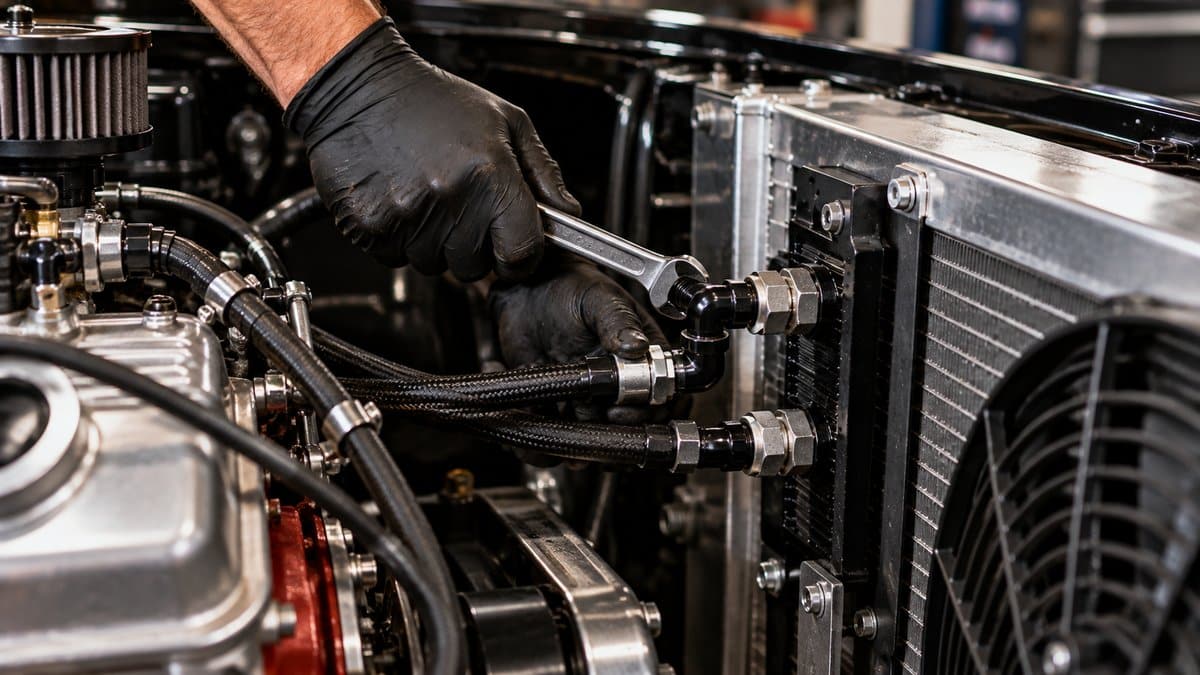
- Run a dedicated external cooler sized for the power, not the factory in-radiator loop. This is the highest-return item on the list.
- Put a temperature gauge in the pan or the line so you are reading the fluid, not guessing from the shift feel.
- Match converter stall to the cam, gear, tire, and weight. A converter slipping at cruise makes heat every mile.
- Keep the fluid full and fresh, and shorten the interval for a car that sees track time, repeat launches, or tow duty.
- Flush or replace cooler lines and the cooler itself after any overheat that put debris into the fluid.
Repair or Replace After an Overheat
One overheat with clean fluid, no metal, and normal shifting after a service is a fluid and cooler job. Fix the cause and drive it.
Replacement is the right call when the pan magnet has metal on it, when slip or flare stays after the fluid is fresh, when the car has cooked itself more than once, or when the repair estimate starts approaching a unit built for the power the car actually makes. At that point you are paying rebuild money to put a factory-spec transmission back behind an engine that already beat it once.
Build the Trans for the Heat It Will See
Overheating is a specification problem before it is a maintenance problem. A unit built around your torque, your converter, and how the car actually gets used runs cooler because less of the energy going through it turns into slip in the first place.
That is how Gearstar builds. One technician assembles each unit start to finish, it is matched to your engine, gearing, and driving style, and it is dyno tested for 100 miles before it ships. You get the dyno video of your own transmission, and the build carries a warranty. The converter gets spec'd with the transmission, not bolted on after, which is the difference between a car that lives at 190 degrees and one that fights 240 every weekend.
Tell us the combination: engine, cam, gear, tire, converter target, and weight. We will spec the unit and the converter around it.
Keep it cool. Keep it together.
FAQs
What causes transmission overheating? Cooling capacity that has not kept up with the power. A built engine sends more torque through the clutch packs and converter than the factory circuit was sized for, so fluid absorbs heat faster than the cooler can shed it. A loose converter, low or oxidized fluid, repeat launches, and track time all add to it.
What are the symptoms of an overheating transmission? A burnt smell off the fluid, dark fluid on the stick, slip under load, delayed engagement that worsens as the car warms, harsh or erratic shifting once hot, and a pump whine. The tell is that the symptoms show up with temperature and ease off after the car sits.
How hot is too hot for a transmission? Above 220 degrees F the fluid starts breaking down faster than it should, and above 240 the clutch packs, seals, and bearings take real damage. Above 260, stop as soon as it is safe. Normal operating range is 175 to 200. A car that regularly sees 220 plus needs more cooler.
Why does my transmission keep getting hot? Usually the cooler, the converter, or the fluid. A factory in-radiator cooler behind a built motor cannot shed the load, a converter that is loose for the cam and gear slips and makes heat continuously, and low or oxidized fluid carries heat poorly. Check fluid first, then converter match, then cooling capacity.
Can a transmission recover from overheating once? Often, yes. If the fluid comes out dark but the pan magnet is clean and shifting returns to normal after a service, replace the fluid, fix the cause, and drive it. If there is metal in the pan or slip persists with fresh fluid, the clutch material is already gone and a service will not bring it back.
Does an external transmission cooler actually help? Yes, and it is the highest-return upgrade on an overheating transmission. A properly sized external cooler sheds heat the factory in-radiator loop cannot, which keeps the fluid inside its protective range during repeat launches and track sessions. Mount it in real airflow and run a gauge so you can see the result.
Do I need a temperature gauge? Yes if the car sees launches, track time, or tow duty. Shift feel is a late indicator, and by the time a trans feels hot the fluid has already spent time above where it protects. A pan or line-mounted gauge lets you back off before damage instead of after.
More From the Shop
How Long Does a Transmission Last? Mileage Is the Wrong Number
A healthy automatic in a stock car runs 150,000 to 250,000 miles. Behind a built...
Car Transmission Repair Cost: What a Built Car Actually Pays
Ask three shops what a transmission repair costs and you get three numbers, and...
Transmission Cooler Lines Replacement Cost, and When Patching Is a Waste of Money
Transmission cooler lines replacement runs $150 to $450 per line for parts and labor, and...