
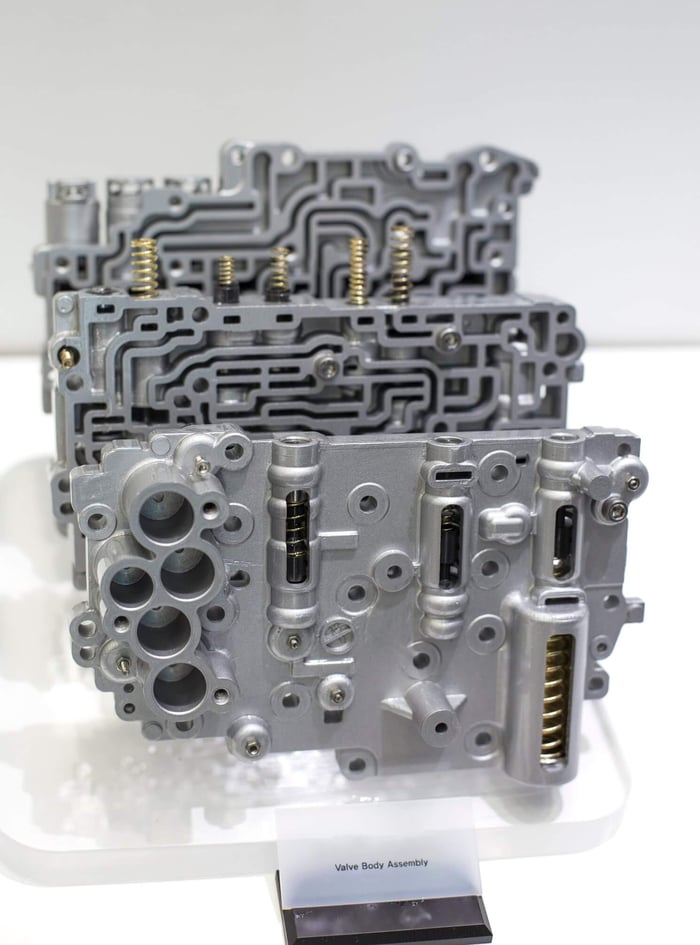
Valve Body Basics: What Does a Valve Body Do in a Transmission?
So, what does a valve body do in a transmission? It directs pressurized fluid to the right clutches and bands at the right moment. The transmission valve body is the hydraulic brain of your automatic. It decides how engine power lands.
It is a precision machined casting, aluminum or iron, bolted to the bottom of the case in the pan area. Inside it are stacked fluid passages, called galleries, and a set of spool valves, springs, checkballs, and on later units, solenoids. A separator plate with calibrated holes sits between the casting halves and sets how fast fluid moves through each circuit.
The transmission valve body reads the vehicle. Throttle position, engine load, vehicle speed, and where you put the lever. Those inputs move valves. As a valve slides in its bore, it uncovers a port and sends high pressure ATF to a clutch pack or servo. One clutch applies, another releases, and you have a shift.
The torque converter couples the engine to the input shaft. The planetary sets provide the ratios. None of that matters if the commands are vague. When a valve body goes soft, shifts land late, pressure bleeds across worn valve lands, and clutches slip instead of locking. Slip makes heat. Heat burns fluid. Burnt fluid eats clutch material, and that material goes right back into the valve body. That is the failure loop, and it runs faster than most people expect.
Direct Impact on Vehicle Performance: Shift Character and Control
Shift feel is a valve body decision. Nothing else in the transmission has as much say in it.
A worn stock unit gives you soft, lazy shifts. Pressure bleeds off across valve lands that no longer seal, so the clutch takes a slow squeeze instead of a clean hit. It feels like the car is thinking about the gear before it takes it. Behind a built engine that is destructive, because every soft shift is clutch material coming off.
A recalibrated or performance valve body does the opposite. Firmer springs, corrected bore work, a separator plate matched to the calibration, and revised shift timing. The clutch applies faster and with more pressure behind it. Less slip, less heat, less wear. That is why builders address the valve body before they chase more power.
Calibration is not one size fits all. A car that leaves hard wants a firm 1 to 2 shift to protect the direct clutches. A tow rig wants a firm 2 to 3 shift under load so the band is not cooking halfway up a grade. Same casting, two setups, and the difference is springs, checkball placement, plate holes, and pressure.
Hydraulic and Electronic Valve Bodies Behave Differently
This is where platform matters, and it is the part most generic valve body articles skip.
Hydraulic units
The TH350, TH400, Powerglide, and C4 use a pure hydraulic valve body. Shift timing comes from a governor driven off the output shaft and a throttle valve linked to the carburetor by cable or rod. No sensors. No wiring. No computer. Everything is fluid pressure arguing with spring pressure.
These are tunable with hardware alone, and a good rebuild with the correct springs and plate holds its calibration for decades. A bad throttle valve linkage adjustment will ruin shift timing on an otherwise perfect unit, so that adjustment is part of the install, not an afterthought.
Electronic units
The 4L60E, 4L80E, 4R70W, and 6L80E use a valve body with shift solenoids and pressure control solenoids on it. The transmission control module fires those solenoids based on throttle position, vehicle speed, gear, and load. The hydraulic work is identical. The decision making moved into a module.
Two consequences. A failing solenoid, a bad temperature sensor, or a corroded connector can wreck a healthy transmission as fast as a worn bore. And a valve body fault on an electronic unit usually leaves a code, often shift solenoid performance or pressure control, which the hydraulic guys never get. Read the codes before you drop the pan.
Line Pressure and Shift Timing
A valve body controls two things that matter. Line pressure and shift timing. Get either wrong and the transmission pays.
Line pressure is the working pressure the pump delivers to the clutches and bands. Too low and the friction elements slip under load. Too high and shifts get harsh, seals wear early, and thrust surfaces take a beating. Every model has a published spec at idle in Park, at idle in Drive, and at wide open throttle. As a rough shape of the curve, common GM three and four speeds sit around 60 to 90 psi in gear at idle and climb toward 150 to 250 psi at full throttle depending on model and calibration. Do not guess on your unit. Put a gauge on the test port and compare to the spec for that transmission.
Shift timing is when the next gear gets commanded. Hydraulic units set it with the governor and throttle valve. Electronic units set it with the TCM. A performance rebuild moves shift points up the RPM range to match an engine that makes power higher. That is a calibration change, not just a stiffer spring, and it has to be done with the engine combination in front of you.
Shift Kit or Full Valve Body Rebuild?
These are not the same purchase, and the difference is worth real money.
A shift kit is springs, checkballs, sometimes a separator plate, and instructions. You install it in the valve body you already have. It firms up shifts and it works fine, on one condition. The bores have to be in good shape. A kit in a worn casting is a stiffer spring pushing a valve that still leaks past its lands. Small improvement, same problem back later.
A full rebuild starts with measurement. The casting comes apart, gets ultrasonically cleaned, and every bore gets checked. Worn bores get sleeved. Worn valves get replaced. Then the assembly is calibrated to the transmission model and to how the vehicle is used, and pressure and shift timing get verified on the bench before the unit goes into a case.
The rule: if the transmission is coming apart anyway, or the fluid has ever been burnt, rebuild the valve body. If the unit is healthy, low mileage, and you only want firmer shifts, a kit is a fair answer.
From Stock to Performance: The Manual Valve Body and Other Upgrades
The most aggressive change is a manual valve body conversion. On a hydraulic unit, it removes the automatic shift logic that the governor and throttle valve provide. You shift with the lever, gear by gear. Hold each gear to the shift point you choose. Powershift on the light. It is standard equipment on a drag car and common on any strip build that wants repeatable sixty foot times.
Understand the trade. Manual valve bodies change engine braking behavior, punish sloppy shifting, and get old fast in traffic. On electronically controlled units the logic lives in the TCM, so the equivalent of a manual conversion is a control strategy change plus valve body work, not just a different casting.
The middle ground is a recalibrated stock style valve body, and that is what most street performance cars and tow vehicles should get. You keep normal Park, Reverse, Neutral, Drive behavior and full driveability, and you gain firmer shifts and better durability. A supercharged big block gets a calibration for its torque curve. A diesel hauler gets one for load and heat. Both are custom work, and both start with the engine, the converter, the gear ratio, and the tire diameter, not a part number.
How Do I Know if My Valve Body Is Going Bad?
Valve body wear shows up as a change in behavior in a transmission that used to shift clean. Use the symptoms to narrow it down, then confirm with a gauge.
Symptom | Likely cause |
Delayed engagement into Drive or Reverse | Low line pressure, worn bore leaking |
Shifts went soft and slushy | Pressure bleed across valve lands |
Harsh banging shifts at part throttle | Pressure control fault, wrong calibration |
Slipping under load on 2 to 3 or 3 to 4 | Circuit cross talk, worn clutches |
Gear hunting on level ground | Shift valve sticking, bad speed signal |
Stuck in one gear, limp mode | Failed shift solenoid, TCM protection |
Diagnostic sequence
Check the fluid first. Level, color, smell. Burnt fluid changes the conversation immediately. Then pull codes if the unit is electronic. Then put a mechanical gauge on the pressure test port and record idle in Park, idle in Drive, and wide open throttle, and compare to the model spec. Then drop the pan and inspect the filter and the magnet for clutch material and metal. Only then is it worth pulling the valve body.
That order saves you from the common mistake, which is buying a valve body to fix a transmission that really has worn clutches, a failed converter, or a wiring fault. If the clutches are down, a fresh valve body just applies pressure to parts that cannot hold it.
What Causes a Valve Body to Wear Out?
Valve bodies do not fail on age alone. Something drives the wear.
Old or contaminated fluid is the biggest cause. ATF is the working fluid, the lubricant, and the coolant. Once it burns, friction characteristics change and viscosity drops, and bore wear accelerates.
Clutch material in circulation is second. Every transmission sheds some friction material over its life. That material collects in screens and solenoid ports and it acts like lapping compound in a valve bore.
Heat cycles are third. Repeated overheating distorts the casting and opens bore clearances. A cooler on any performance or towing application is cheap next to a rebuild.
Wrong fluid spec and stuck solenoids round it out. Run the fluid the model calls for. On electronic units, a stuck solenoid holds pressure wrong and beats on the valve behind it.
Fluid service on schedule, the correct spec, and adequate cooling buy back years of valve body life. Converter condition matters too, since a converter making excess heat pushes that heat straight through the valve body, so a slipping converter gets addressed with the transmission. Browse the full transmission lineup if yours is past saving.
Why a Professional Rebuild is Critical for Performance
Tolerances inside a valve body are tight. Bores stay round or they leak. Valves move freely or they stick. Wear opens cross talk between circuits, and gears overlap or drop out under load.
DIY rebuilds miss the subtle work. Seals and springs get swapped, bores never get measured, and the sleeving the casting needed never happens. That is the rebuild that comes back on a trailer.
Every Gearstar unit gets the valve body worked to spec. Full disassembly, ultrasonic cleaning, every bore measured, valves replaced where needed, springs and plate matched to the model and the customer combination, and pressure and shift timing verified before assembly. Then the finished transmission gets dyno tested.
Ensure Consistent Shifts with the Right Valve Body
The valve body is the link between your right foot and the pavement. Ignore it and you leave consistency, durability, and clutch life on the table.
Every GM performance transmission and Ford performance transmission we build is assembled by one builder, matched to your engine and how the vehicle gets used, and dyno tested before it ships. Tell us the engine, the converter, the rear gear, the tire size, and how you drive it, and we will spec the valve body calibration to match.
Call Gearstar at 330-434-5216 to spec a custom built, dyno tested performance transmission for your combination.
More From the Shop
What Is a Billet Direct Drum? Strength, Design, and Why It Matters
If there were a popularity contest in the world of transmission components, the...
4L80E Direct Drum in Performance Rebuilds
In the hierarchy of critical components inside a 4L80E, the direct drum rarely...
Essential 6L90 Transmission Upgrades
If there’s one thing GM got right with the 6L90 transmission, it’s that they built...