
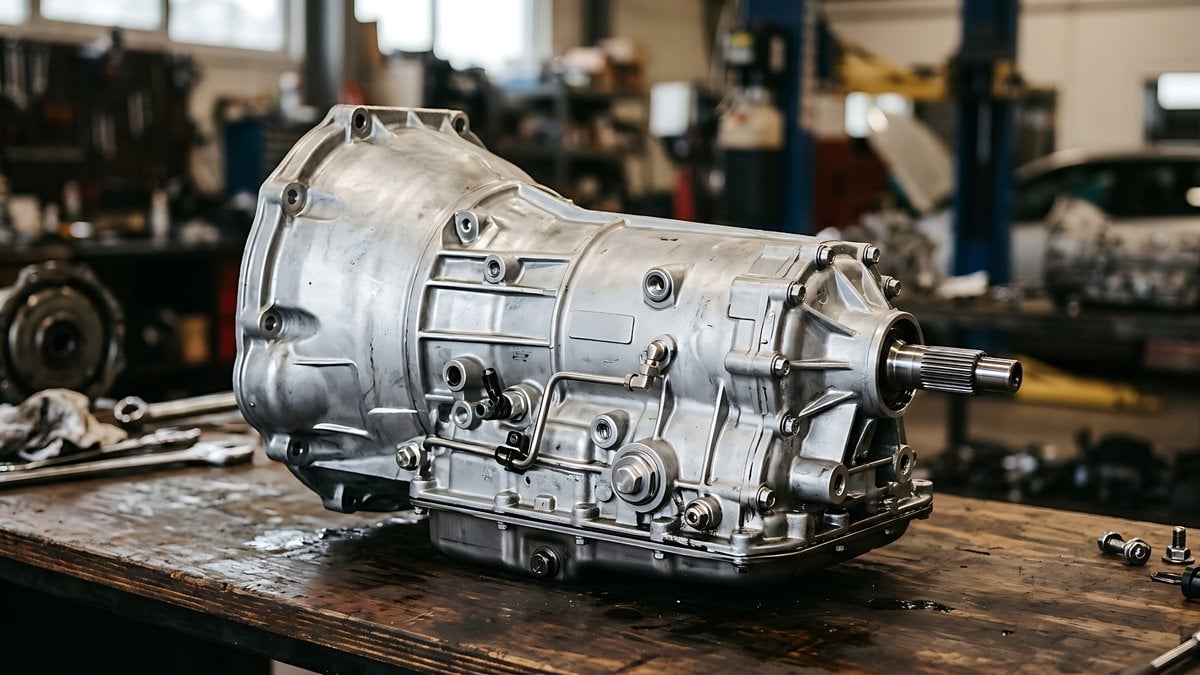
What Is an Automatic Transmission and How Does It Work Behind a Built Motor
How Does an Automatic Transmission Work?
An automatic transmission multiplies engine torque through fluid, then uses hydraulic pressure to hold and release clutch packs and bands inside a planetary gearset so gear ratio changes without breaking the power path. Everything else, the converter, the pump, the valve body, the TCM, exists to decide when that happens and with how much pressure.
That last part is the whole story on a modified car. The mechanical layout of a 700R4 is the same whether it lives behind a stock 305 or a 468. What changes is the torque flowing through it and the pressure and clutch capacity required to hold that torque without slip. Most guys already know what the parts are called. Fewer know which ones set the ceiling on what the unit will take.
The Power Path, Component by Component
Torque converter. Fluid coupling with a stator, and the stator is why it multiplies torque instead of just transmitting it. Stall speed is the RPM where the converter starts to couple and put power to the gearset. Set stall for the cam, gear, tire, and weight of the car and it launches out of the converter into the torque curve. Set it 800 RPM off and the car either bogs off the line or flashes past the powerband and spins.
Planetary gearset. Sun, planets, ring, carrier. Holding one member and driving another produces a ratio. Nothing disengages during the change, which is why an automatic keeps making torque through a shift while a manual gives up the drive for a beat. It is also why hard parts crack instead of slipping when they get overloaded.
Clutch packs and bands. These hold the planetary members. Clutch count, friction material, and steel thickness set the torque the unit will hold before it slips. This is the number that gets outgrown first on a built car, and no valve body or fluid choice compensates for a pack that is short on capacity.
Pump and valve body. The pump makes line pressure. The valve body routes it. Line pressure is what clamps the clutches, so pressure that is low for the application means slip and heat even with a fresh set of frictions. A shift kit or a manual valve body raises and quickens that apply, which is why a properly kitted unit hits when it shifts.
Fluid. It is the working hydraulic medium, the coolant, and the friction control all at once. Heat kills the friction modifiers, and once they are gone the clutch material goes with them. Cooling capacity is a build decision on any car making repeat launches.
TV cable or TCM. On a cable unit like a 700R4 or 200-4R, the TV cable sets line pressure and shift timing off throttle position, and a cable a hair out of adjustment will burn clutches in a perfectly built transmission. On an electronic unit like a 4L60E or 4L80E, the TCM does that job from speed, RPM, throttle, and fluid temp, and the tune sets shift points and pressure.
Types of Automatic Transmission, and Which Ones Matter Here
There are four common architectures. Only one of them belongs behind a built V8.
| Type | How it changes ratio | Where it lives | Behind a built motor |
|---|---|---|---|
| Torque converter automatic | Planetary gearsets, hydraulic clutches and bands | TH350, TH400, 700R4, 200-4R, 4L60E, 4L80E, C4, C6, AOD | The one that holds. Serviceable, buildable, converter tunable to the combo |
| CVT | Belt or chain between variable pulleys | Compacts, hybrids | Not a performance path. Belt clamp force sets the torque limit |
| Dual clutch | Two clutches, odd and even gears preselected | OEM sports cars | Quick, but a factory-integrated unit, not a swap part |
| Automated manual | Manual gearbox with actuators | Budget OEM applications | No real aftermarket for classic iron |
Different types of automatic transmission come up constantly in swap threads. For a restomod, a pro-touring car, or a street and strip build, the decision is not converter automatic versus CVT. It is which converter automatic: three speed or overdrive, cable or electronic, and how much clutch capacity behind the torque you actually make.
- TH350 and TH400: three speed, no overdrive, hard parts that take abuse. TH400 for high torque and big-inch motors.
- 700R4 and 200-4R: cable-controlled overdrive units that drop highway RPM in classic iron without a computer. The TV cable is the make-or-break setup item.
- 4L60E and 4L80E: electronic overdrive. The 4L60E is the common LS swap unit, the 4L80E is what you go to when torque outruns the 4L60E's capacity.
- C4, C6, AOD: the Ford equivalents, same logic. C6 for capacity, AOD when you want the overdrive.
What Actually Decides Whether It Holds
Three inputs decide it, and horsepower is not one of them by itself.
- Torque at the input shaft, not peak power. A big-inch motor with a mild cam makes a harder hit at 2,800 RPM than a peaky combination making a bigger number on paper. Clutch capacity and hard parts get spec'd to that.
- Converter stall matched to the combination. Cam, gear, tire diameter, and vehicle weight. A stall picked off a horsepower chart is a guess.
- Line pressure calibrated to the application. Too low and the clutches slip while they apply, which is heat. Too high everywhere and you beat the hard parts on part-throttle shifts.
- Cooling capacity sized for how the car gets used. Repeat launches on a high-stall converter put heat into the fluid faster than a factory cooler was ever asked to shed it.
- Gearing and tire diameter honest on paper. Overdrive ratio and rear gear together decide cruise RPM. Get it wrong and the overdrive you swapped in for the highway is useless.
Every one of those is a specification decision made before the unit gets assembled. That is why a shelf rebuild with a shift kit behaves like a shelf rebuild with a shift kit.
Why a Factory-Spec Automatic Gives Up First on a Built Car
A production transmission was engineered around a production torque curve with margin for warranty, not for a cam, a gear, and a sticky tire. Ask it to hold more and it does not fail politely. Clutch material goes, the fluid cooks, the fluid stops protecting what is left, and the wear accelerates from there.
The sequence is always the same. Slip under load, then flare between gears, then dark fluid with grit in it, then it does not move. Everything after the first symptom is secondary damage bought by waiting.
Spec the Unit Around Your Combination
A transmission is not a category purchase. It is a set of decisions: clutch count, friction material, hard parts, line pressure calibration, valve body, gear ratio, and converter stall, all made against one specific engine in one specific car.
That is how Gearstar builds. One technician assembles your unit start to finish, so there is one person accountable for it. It is matched to your engine, your gearing, and how you actually drive the car. It is dyno tested for 100 miles before it ships, and you get the dyno video of your transmission, not a stock clip. The build carries a warranty.
Tell us the combination: engine, cam, gear, tire, converter target, and weight. We will spec the unit around it.
Spec it to the combo. Drive it, don't rebuild it.
FAQs
How does a transmission work? A transmission changes the ratio between engine speed and wheel speed so the engine stays in its usable RPM range at any road speed. An automatic does it with a torque converter feeding a planetary gearset, where hydraulic pressure applies clutch packs and bands to hold different gearset members and produce each ratio, with no interruption in the power path.
How does an automatic transmission work without a clutch pedal? The torque converter replaces the driver-operated clutch. It is a fluid coupling with a stator, so it slips at idle, multiplies torque off the line, and couples as RPM rises past the stall speed. Gear changes themselves happen inside the transmission, applied hydraulically by the valve body under command of a TV cable or a TCM.
What is an automatic transmission made up of? Torque converter, planetary gearsets, clutch packs and bands, pump, valve body, fluid, and a control input that is either a TV cable or a transmission control module. The converter handles engine-to-transmission coupling and torque multiplication. The gearsets make the ratios. Clutches and bands hold them. Pressure and control decide when and how hard.
What are the types of automatic transmission? Four: torque converter automatics, CVTs, dual clutch transmissions, and automated manuals. For classic iron and swaps, the torque converter automatic is the only real path, since it is the only one that can be built, spec'd, and converter-matched to a specific combination. Within that group the split is three speed versus overdrive, and cable versus electronic control.
What are the different types of automatic transmission for a swap? For GM: TH350 and TH400 three speeds, 700R4 and 200-4R cable overdrives, 4L60E and 4L80E electronic overdrives. For Ford: C4, C6, and AOD. Pick on torque capacity first, then on whether you want overdrive and whether you are willing to run a controller.
How does automatic transmission fluid affect how it works? Fluid is the hydraulic medium, not just lubricant. Line pressure exists because the pump moves fluid, so pressure and clutch clamping depend on fluid level and condition. Heat degrades the friction modifiers that let clutches hold torque, which is why cooling capacity is part of the build on any car making repeat launches.
How do I know which automatic transmission my build needs? Start with torque at the crank and how the car gets used, not peak horsepower. Then set gear ratio and tire diameter, then converter stall, then clutch capacity and hard parts to match. Any unit spec'd from those inputs will outlive one picked because it physically bolts up.
More From the Shop
What Stall Converter Do You Actually Need? How to Choose One for Your Cam and Build
Most stall converter shopping starts with a number. Somebody on a forum runs a 3,000...
How to Identify Your GM Transmission by Shape and Numbers
A swap meet core with no tag. A project car with a transmission nobody can vouch...
What is a Transmission? A Guide for Beginners and Gearheads
If there were a crown for “most mysterious car component,” the transmission would...