
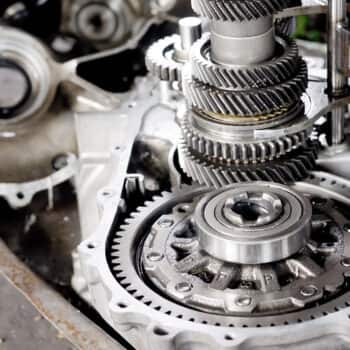
The ABCs of a 4 Speed Automatic Transmission
Why Do Vehicles Need a Transmission?
A transmission exists because an engine only makes useful power inside a narrow RPM band, and a car needs to move from a stop to highway speed. The transmission multiplies engine torque at low speed and tapers that multiplication as road speed climbs.
An engine makes torque. That torque has to reach the rear wheels. The path runs crankshaft to transmission, transmission to driveshaft, driveshaft to differential, differential to axles, axles to wheels. Bolt a driveshaft straight to the crank and one of two things happens. Either the engine cannot pull the car off the line, or the crank takes a shock load it was never designed to absorb.
A stock street engine idles somewhere near 800 RPM and runs out of breath a bit past 6,000 RPM. That is the whole window you get. Gearing is what stretches that window across every road speed the car will ever see.
Transmission's Primary Goal
Keep the engine inside its useful RPM band while the vehicle covers a wide range of speeds. That is the entire job.
At launch you want a deep ratio to get mass moving. As speed builds you want taller ratios so the engine settles into a cruise RPM instead of screaming. When you need power again for a pass or a grade, the transmission has to drop back into a lower gear and put the engine back in its power band.
Every automatic does this with planetary gearsets, clutches, bands, and a valve body that decides when to apply what. A manual does it with the driver's left foot and right hand. The automatic does it on its own.
Two Major Types of Transmissions Exist
Manual transmission. The driver picks the gear, works the clutch, and manages engagement. Fewer parts, direct control, more work to drive.
Automatic transmission. A hydraulic control body picks the gear from vehicle inputs. The driver only works throttle and brake.
Electronic control is not a third type of transmission, and this is where a lot of writing on the subject goes wrong. An electronically controlled automatic is still a hydraulic automatic. Solenoids in the valve body replace the governor and throttle valve, and a transmission control module fires those solenoids based on throttle position, road speed, gear selection, fluid temperature, and load. A TH350 or TH400 is pure hydraulic. A 4L60E or 4R70W is electronically controlled. Same architecture underneath, different way of deciding when to shift.
What Is a 4 Speed Automatic Transmission?
A 4 speed automatic gives you four forward gear ratios plus reverse, and it selects between them without driver input beyond the throttle. Typically first gear is a deep launch ratio, second is intermediate, third is 1:1 direct drive, and fourth is an overdrive ratio below 1:1.
Typical published ratios on the common domestic units put first gear somewhere around 3.0 to 3.5:1 and overdrive around 0.70:1, depending on the model. Confirm the exact numbers for your unit before you order gearing, because the ratio spread changes what rear end gear you want.
That overdrive gear is the reason the 4 speed automatic replaced three-speeds like the TH350 and TH400 in daily drivers. At highway cruise a three-speed holds the engine at its 1:1 output. A 4 speed drops engine RPM in fourth, which cuts fuel burn, cuts noise, and cuts heat.
Most passenger cars fitted with 4 speed automatics from the factory were built through the 1990s and early 2000s. Examples run from the Subaru Forester, Scion xB, and Dodge Avenger to the Toyota Tacoma, Corolla, and Yaris. For American performance work, the families that matter are the GM 700R4 and 4L60E line, the GM 4L80E and 4L85E, the Ford AOD, AODE, and 4R70W, and the Chrysler 42RE, 46RE, and 47RE.
Which Is Better, a 4 Speed Automatic Transmission or a 5 Speed Automatic Transmission?
Neither one is better in the abstract. A 5 or 6 speed gives tighter ratio spacing and an extra overdrive, which helps highway fuel economy and shift feel. A 4 speed gives you a simpler, cheaper to rebuild, easier to install package that drops into most classic and pro-touring chassis without a computer, a CANbus, or an adapter.
Tighter spacing means the engine falls a smaller amount of RPM on each upshift, so it stays closer to its power peak. That is a real advantage on a modern combo. Modern units like the 6L80E and 6R80 also bring better lockup strategy and more overdrive range. If your build already has the wiring and control side handled, they are strong choices.
But there is a cost side. More gears means more clutch packs, more solenoids, more control complexity, and more that has to be tuned correctly before it lives a long life. A 4 speed automatic has fewer failure points and a deeper, cheaper parts supply. For a project car, a tow rig, or a swap where you do not want to solve an electronics problem before you solve a driving problem, a well-built 4 speed is usually the smarter transmission.
Anatomy of a 4 Speed Automatic
Under the case, every domestic 4 speed automatic uses the same core building blocks.
Torque converter. A fluid coupling that transfers engine torque to the input shaft and lets the engine idle in gear. It also multiplies torque at low RPM, and stall speed selection is what matches the converter to the engine's power curve.
Planetary gearsets. The source of every ratio the transmission provides. Hold or release the sun gear, ring gear, or planet carrier and the same gearset produces different output ratios.
Clutches and bands. Friction elements that hold or release planetary members to change gears. Wet clutches live in ATF and depend on clean fluid and correct line pressure.
Valve body. The hydraulic brain. On older units a governor and throttle valve set shift timing. On electronic units, solenoids fired by the TCM do that job.
Pump. Driven off the converter hub. It generates the line pressure that applies every clutch and band in the unit.
Input and output shafts. Torque in from the engine, torque out to the driveshaft.
The differences between a 700R4, a 4L80E, and a 4R70W come down to case dimensions, clutch pack count and size, planetary tooth count, and control strategy. Not architecture.
How Each 4 Speed Platform Behaves
GM 700R4 and 4L60E
The 700R4 is the hydraulic ancestor, and the 4L60E is the electronic version of the same case. Both have a deep first gear that launches hard and an overdrive that cruises well. Both are also the lightest duty of the GM performance 4 speeds. Add power and the sun shell and 3-4 clutch pack are what you address first. TV cable adjustment on a 700R4 is not optional. Get it wrong and you will burn the unit down from low line pressure.
GM 4L80E and 4L85E
Heavier case, more clutch capacity, truck duty. The 4L80E is the choice when the combo makes real torque or the vehicle tows. It is longer and heavier than a 4L60E, so plan for crossmember and driveshaft changes on a swap.
Ford AOD, AODE, and 4R70W
The AOD is hydraulic with a split-torque third gear design that behaves differently than a GM unit under part throttle. The AODE and 4R70W are electronic, and the 4R70W adds a better ratio spread that suits a small block Ford well. Direct clutch drum splines and the intermediate one-way clutch are the usual wear items across the family.
Chrysler 42RE, 46RE, and 47RE
Truck-oriented units with a hydraulic base and electronic overdrive and converter clutch control. Input drum and pump issues top the list. Governor pressure solenoid and sensor faults produce shift complaints that get misread as mechanical failure, so scan before you pull the pan.
Symptom to Cause
Symptom | Likely cause |
Slipping in 3rd and 4th | Worn 3-4 clutch pack or low line pressure |
No 4th gear, no overdrive | Solenoid or TCM signal fault |
Shudder at light throttle cruise | Converter clutch apply problem |
Delayed engagement when cold | Low fluid or worn pump |
Burnt fluid smell, dark ATF | Overheating and clutch material breakdown |
Use this as a starting point, not a verdict. Confirm with pressure and scan data before you order parts.
Diagnostic Sequence
Work in this order and you will stop guessing.
- Check fluid level and condition on a warm unit, on level ground, engine running.
- Scan for stored codes and look at live data for gear commanded versus gear achieved.
- Verify line pressure against the service spec for your unit at idle and at stall.
- Road test through every upshift and downshift, noting which shifts are wrong and at what throttle.
- Only then drop the pan and read the debris in it.
Common 4 Speed Automatic Applications
- 80s and 90s GM trucks and SUVs, 700R4 and 4L60E
- Fourth-gen Camaros and 90s Corvettes, 4L60E
- Full-size GM trucks and heavy duty, 4L80E and 4L85E
- Fox-body and SN95 Mustangs, AOD, AODE, and 4R70W
- Super Duty and E-Series Fords, 4R100
- Dodge trucks, 46RE and 47RE
Every one of these platforms has an active builder community and room for a real performance rebuild. Browse the full lineup of Ford performance transmissions or the complete transmission catalog to see what a built version of your unit includes.
Manual Valve Body Conversions
For race use, a 4 speed automatic gets more capable with a full manual valve body. The driver picks the gear and the transmission holds it until the driver moves the lever. No shift logic, no governor, no throttle valve.
You get a consistent driver-selected shift RPM, no surprise downshift mid-launch, less parasitic loss inside the valve body, and clean control on a transbrake launch. The tradeoff is that the driver shifts every gear, every time. That is fine on a strip car and wrong on a street car or a tow rig. Treat it as a race-only conversion.
How Long Does a 4 Speed Automatic Last?
Service life comes down to load, fluid maintenance, and how the shift schedule is calibrated. A typical figure quoted for a stock 4 speed automatic in a daily driver, kept in clean fluid on a reasonable service interval, is somewhere in the range of 150,000 to 250,000 miles before a rebuild. Trucks in tow service and performance cars seeing repeated wide-open throttle come in lower. That is a use-case outcome, not a design flaw.
The failure patterns are well documented per family, and every one of those parts has upgraded aftermarket replacements. That is the practical argument for the platform. When a 4 speed does fail, you know what failed and the fix is known work.
Fluid, Filter, and Cooling
Three variables decide whether your unit sees 200,000 miles or 80,000.
Fluid. Use the ATF spec called out for your unit, or a quality synthetic that meets or exceeds it. Wrong fluid chews clutch material fast and the damage is not reversible.
Service interval. Drop the pan and change the filter in the commonly recommended 30,000 to 60,000 mile window in normal service. Cut that in half for tow or track use.
Cooling. Stock coolers are marginal under load. An external cooler sized for the vehicle keeps ATF near the commonly cited 175 to 200 degree working range. Heat is what kills automatics, so cooling is the cheapest life extension you can buy.
Spec Your Build
Gearstar builds custom performance automatic transmissions to match your engine, your gearing, and how you actually drive the car. One builder handles your unit start to finish, and every transmission is dyno-tested before it ships. Call 330-434-5216 to spec a build.
More From the Shop

Sports Cars That Are Faster with an Automatic Performance Transmission
Some luxury cars with automatic transmission include the Lexus ISF, BMW M4/M5, Audi...